Battlefield 3: The Dawn of Total War
The first-person shooter genre where groundbreaking technology met massive-scale warfare, forever altering the multiplayer landscape.
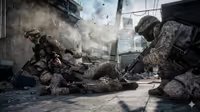
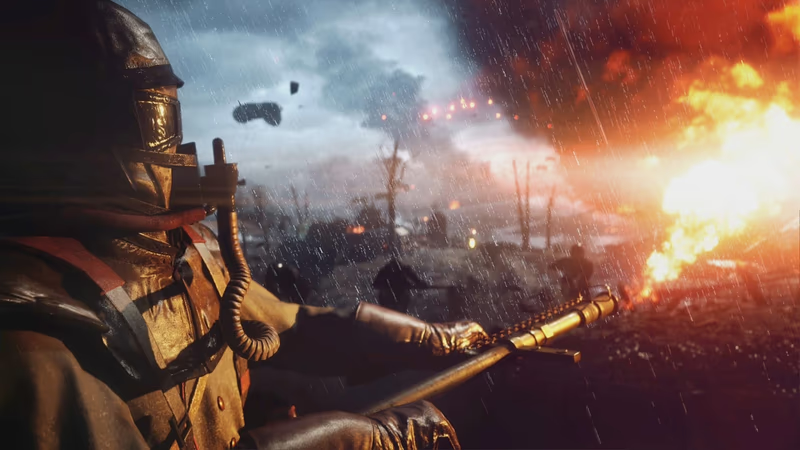
Image captured on Xbox Series X

When the first-person shooter industry was desperately strapping jetpacks onto players and racing toward distant, futuristic sci-fi settings, DICE and Electronic Arts made a fiercely counter-cultural decision. They looked backward. Releasing in 2016, Battlefield 1 took the massive scale the franchise was known for and plunged it into the mud, blood, and mustard gas of the early 20th century. It was a massive commercial risk that paid off beautifully, delivering an experience so raw and immersive that it immediately cemented itself as a modern classic.
Battlefield 1 abandons the overused battlefields of WWII to explore the harrowing, industrialized slaughter of the First World War (1914-1918). What makes the setting so effective here is that DICE didn't just focus on the infamous muddy trenches of the Western Front.
The action sweeps across a truly global theater. You will fight through the foggy, claustrophobic forests of Argonne, charge on horseback across the scorching sands of the Sinai Desert alongside Bedouin rebels, engage in deadly mountain warfare in the Italian Alps, and storm the fortified beaches of Gallipoli. It is a grim, grand-scale tour of a world tearing itself apart at the dawn of modern warfare.
If there is one aspect where Battlefield 1 remains practically untouchable, it is its technical presentation. The Frostbite engine was pushed to its absolute limits, utilizing photogrammetry to create landscapes that look terrifyingly real. The dynamic weather system means a sunny match in the French countryside can suddenly be engulfed by a blinding fog or a torrential downpour, completely altering sniper sightlines and forcing brutal, close-quarters engagements.
However, the true star of the show is the sound design. From a journalistic and technical standpoint, the audio in Battlefield 1 is a masterclass in inducing virtual shell shock. The terrifying, metallic screech of a falling Zeppelin, the muffled panic inside a gas mask as your character breathes heavily, the distinct ping of a sniper's kill, and the chilling sound of an officer's trench whistle preceding a synchronized bayonet charge—it is a chaotic, deafening symphony of destruction.
Rather than forcing a single, unrealistic supersoldier narrative across a four-year global conflict, the campaign is divided into "War Stories." This anthology format follows different individuals across various fronts: a British tank crew desperately pushing through France, an Italian Arditi shock trooper searching for his brother, or a rebel fighter working with Lawrence of Arabia.
It handles the subject matter with a surprising amount of gravity. This is best exemplified by the game's unforgettable prologue, "Storm of Steel." Here, you don't play to win; you play to die. Every time your soldier falls, the game pauses to display their name and birth/death years before seamlessly transitioning you into the boots of another doomed soldier across the battlefield. It is a sobering reminder of the conflict's horrific human cost.
The multiplayer suite is where the community lived, and it was received with overwhelming praise. The chaotic 64-player matches felt heavier and more grounded than in previous titles.
DICE introduced two revolutionary concepts here:
Pros:
Cons:
Now a decade old, Battlefield 1 has aged like a fine, albeit blood-stained, wine. When we look back at the missteps the franchise took in the years following its release—the identity crisis of Battlefield V and the sterile, controversial launch of Battlefield 2042—this 2016 entry stands incredibly tall.
Graphically and acoustically, it effortlessly holds its own against current-generation releases. Its servers remain active because it offers an atmospheric intensity that no other game has successfully replicated. Battlefield 1 is not just a high point for DICE; it is one of the most cohesive, visually arresting, and thrilling multiplayer shooters ever made.

Affiliate link: Support the blog via Instant Gaming at no extra cost.
Battlefield 1
Others Posts
The first-person shooter genre where groundbreaking technology met massive-scale warfare, forever altering the multiplayer landscape.
A retrospective on Star Wars: Republic Commando: LucasArts' gritty military shooter, the brotherhood of Delta Squad, the iconic visor HUD, and the power of "Vode An."
Two decades later, Valve’s magnum opus remains the undisputed gold standard for first-person shooters and a towering legend in the interactive medium.
In an era where third-person shooters were defined by chest-high walls, muddy color palettes, and slow, methodical pacing, PlatinumGames decided to strap rocket boosters to the genre's knees. Directed by the legendary Shinji Mikami

The universe of Anthem was rich with untapped potential, leaning heavily into a "science-fantasy" aesthetic.
A retrospective on Call of Duty 2: Infinity Ward's WWII masterpiece, the revolution of regenerating health, and its impact on the Xbox 360 era.
Are the Minecraft Dungeons DLCs worth buying? We break down all 6 expansions, their biomes, unique mechanics, boss fights, and rank the absolute must-haves.
Master turn-based combat in Gears Tactics. Learn to chain executions for infinite Action Points, optimize class builds, and crush colossal bosses.

Analysis of the PlayStation 4 and PS4 Pro hardware. We examine the shared CPU bottleneck, the mirrored butterfly GPU design, memory optimizations, and the hardware-level checkerboard rendering that enabled the 4K transition.

PlayStation 5 Pro hardware: PSSR, Advanced Ray Tracing, and the AI Revolution. We analyze Sony's PlayStation Spectral Super Resolution (PSSR), RDNA 4 Ray Tracing advancements, and the engineering behind the end of the Fidelity vs. Performance compromise.
guides
Conquer the toughest bosses in Minecraft Dungeons. Master attack patterns, exploit weak points, and equip the best builds for every major fight.
