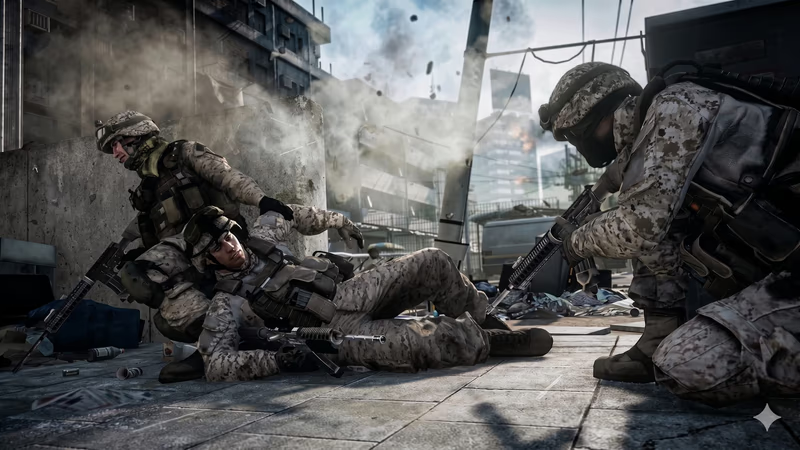
Image captured on Xbox Series X and retouched with Nano Banana.
Set against the backdrop of a fictional global conflict in the year 2014, Battlefield 3 places players in the boots of US Marines, Russian Spetsnaz, and tank operators as they race across the globe—from the streets of Paris and Tehran to the heart of New York—to stop a devastating nuclear threat from a paramilitary group known as the PLR. However, while the game provided a globe-trotting narrative, its true context was real-world industry dominance.
The Great Duel: Taking on Modern Warfare 3
The autumn of 2011 was an unforgettable time to be a fan of the shooter genre. Electronic Arts and DICE did not just release a game; they declared war on the undisputed king of the hill, Call of Duty: Modern Warfare 3. The marketing was aggressive, drawing a clear line in the sand. While Call of Duty offered fast-paced, arcade-style infantry combat in tight arenas, Battlefield 3 offered a massive, tactical sandbox. It was a clash of philosophies: the lone-wolf twitch shooter versus squad-based, combined-arms warfare. For many of us, this was the moment we realized that military shooters could be so much larger than a 6v6 skirmish.
Frostbite 2: A Technical Beast
As a fan of the genre, booting up Battlefield 3 for the first time was a revelation. It felt like playing a game from five years in the future, entirely thanks to the Frostbite 2 engine.
Lighting and Destruction: The micro-destruction was a game-changer. You couldn't just hide behind a concrete barrier forever; heavy machine-gun fire would chip it away until you were exposed. You could blow out the facades of buildings in Parisian alleyways, dropping rubble on enemies below. The dynamic lighting meant tactical flashlights and laser sights could physically blind you in dark corridors, adding a terrifying layer of realism to close-quarters firefights.
Sound Design: DICE has always been the industry standard for audio, but BF3 was a masterpiece. The sound was dynamic. A sniper shot passing your head cracked like a whip in an open field, but echoed deafeningly in an underground subway. The mechanical roar of an A-10 Warthog flying low over the battlefield still induces a visceral reaction.
Aesthetics: Visually, the game was defined by its cold, gritty realism, characterized by its heavily debated blue color-grading and J.J. Abrams-style anamorphic lens flares. It gave the warzone a distinctly cinematic, slightly sterile look that became the visual signature of the era.
Multiplayer: The Heart of the War
The multiplayer suite was where Battlefield 3 achieved immortality. The map design was nothing short of brilliant, accommodating wildly different playstyles within the same game. Two maps perfectly encapsulate this dichotomy:
Operation Metro (Rush Mode): The ultimate infantry meat grinder. Starting in a sunny Parisian park, players were pushed down into the claustrophobic, dark subway tunnels. It was a chaotic, grenade-spamming battle of attrition that tested your reflexes and squad healing capabilities to the absolute limit.
Caspian Border (Conquest Mode): This was the definitive Battlefield experience. A massive, open sandbox featuring 64 players (on PC), fighter jets dogfighting in the clouds, tanks rolling through the forests, and the iconic, towering communications antenna crashing down in the middle of the match. It was tactical, vehicle-heavy, and required actual squad communication to lock down capture points.
The Campaign: A Beautiful Failure
As much as I adore this game, honesty is required when looking back at the single-player campaign. It was, undoubtedly, the game's weakest link. In a desperate attempt to steal the cinematic crown from Call of Duty, DICE abandoned the open-ended, tactical freedom that makes Battlefield great.
Instead, they forced us into a highly scripted, narrow corridor shooter filled with Quick Time Events (QTEs) and invisible walls. You played as Sergeant Blackburn going through interrogation flashbacks—a narrative device that felt highly derivative. While it featured jaw-dropping set pieces, like the carrier jet launch or the tank assault in the desert, you were never allowed to actually think for yourself. If you stepped out of bounds to flank an enemy, the game instantly killed you. It was a gorgeous tech demo, but a remarkably frustrating game.
Frostbite 2 Engine: A generational leap in graphics, lighting, and destruction.
Unrivaled Audio: The best, most terrifyingly realistic weapon and vehicle sound design of its generation.
Masterful Map Design: Environments like Caspian Border, Grand Bazaar, and Noshahr Canals offered perfect layouts for both infantry and vehicles.
Gunplay & Customization: Weapons felt heavy, punchy, and featured deep attachment progression.
Cons:
The Campaign: Too linear, heavily scripted, and completely counter to the franchise's sandbox identity.
Battlelog: Forcing PC players to launch the game through a web browser was a highly controversial and often clunky experience at launch.
Blue Tint: The heavy blue color filter was visually fatiguing for some players.
Conclusion
Looking back as a dedicated fan of the genre, Battlefield 3 is a tale of two extremes. The campaign was a forgettable, restrictive misstep that failed to understand its own franchise's strengths. But the multiplayer? The multiplayer consumed hundreds of hours of my life and I don't regret a single second.
The true legacy of Battlefield 3 lies in its map design and the sheer, breathtaking leap forward provided by the Frostbite 2 engine. It proved that 64-player matches with jets, tanks, and collapsing buildings weren't just possible, but could run beautifully. It set a towering standard for what a large-scale military sandbox should feel like—a standard that many argue DICE themselves, and their competitors, have been trying to perfectly replicate ever since.
Affiliate link: Support the blog via Instant Gaming at no extra cost.
Battlefield 3
Developer: DICE
Publisher: Electronic Arts
Engine: Frostbite 2
Genre: First-Person Shooter
Release date: October 25, 2011
Duration: 6-7 hours
Available on
PCPlayStation 3Xbox 360
Others Posts
Super Mario RPG: A 16-Bit Miracle Beautifully Reborn on the Switch
We analyze the return of the legendary alliance between Nintendo and Square. A remake that strictly honors its 1996 roots while dressing up in gorgeous diorama graphics and polished combat.
We explore how Nintendo dominated the 16-bit console war not through sheer CPU speed, but through a masterful integration of custom audio-visual processors, revolutionary controller ergonomics, and an ingenious strategy of in-cartridge hardware expansion.
A step-by-step guide to solving Toadofsky's first musical puzzle at Tadpole Pond, earning the Alto Card, and unlocking powerful party-wide healing items at the Juice Bar.
We explore the Nintendo GameCube's surprisingly muscular architecture, its quirky, toy-like design, and the brutal market realities it faced against the DVD-playing juggernauts of its era.
Minecraft Dungeons DLC Guide: Every Expansion Ranked & Analyzed
Are the Minecraft Dungeons DLCs worth buying? We break down all 6 expansions, their biomes, unique mechanics, boss fights, and rank the absolute must-haves.
Minecraft Dungeons DLC Guide: Every Expansion Ranked & Analyzed
Are the Minecraft Dungeons DLCs worth buying? We break down all 6 expansions, their biomes, unique mechanics, boss fights, and rank the absolute must-haves.
Analysis of the PlayStation 4 and PS4 Pro hardware. We examine the shared CPU bottleneck, the mirrored butterfly GPU design, memory optimizations, and the hardware-level checkerboard rendering that enabled the 4K transition.
PlayStation 5 Pro hardware: PSSR, Advanced Ray Tracing, and the AI Revolution. We analyze Sony's PlayStation Spectral Super Resolution (PSSR), RDNA 4 Ray Tracing advancements, and the engineering behind the end of the Fidelity vs. Performance compromise.
guides
Minecraft Dungeons Boss Guide: Strategies to Defeat Every Boss
Conquer the toughest bosses in Minecraft Dungeons. Master attack patterns, exploit weak points, and equip the best builds for every major fight.