Half-Life 2: The Crowbar That Shifted the Tides of Gaming History
Two decades later, Valve’s magnum opus remains the undisputed gold standard for first-person shooters and a towering legend in the interactive medium.
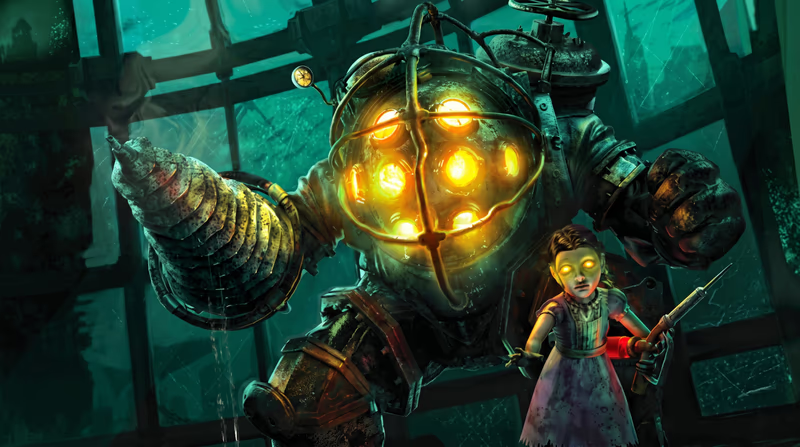
Rapture's crumbling art deco grandeur, the setting of BioShock.

Rapture sits at the bottom of the Atlantic, a city built by industrialist Andrew Ryan to escape government, religion, and "petty morality." By the time your plane crashes into the ocean above it in 1960, that dream has already drowned. BioShock, released on August 21, 2007 by Irrational Games (then operating as 2K Boston) with 2K Australia, took the bones of System Shock 2's immersive-sim design and wrapped them around one of gaming's most quoted openings: a bathysphere ride down into a city lit by neon and leaking seawater. Eighteen years on, it still reads as the moment the first-person shooter grew a conscience.
The genius of Rapture is that none of its story arrives as a cutscene lecture. Audio diaries scattered through the Medical Pavilion, Arcadia, and Fort Frolic let the player assemble Ryan's fall from idealist to tyrant in fragments, overheard rather than explained. Splicers, Rapture's gene-addicted remnants, shuffle through hallways muttering half-remembered lives while Art Deco murals peel off the walls behind them. The environmental storytelling here set a template the entire industry copied for the next decade, and few have matched the density of detail packed into a single flooded hallway.
Combat splits down two tracks that the game forces you to juggle simultaneously: a right hand holding a wrench, shotgun, or chemical thrower, and a left hand wired with Plasmids, gene-spliced powers injected straight into the bloodstream. Electro Bolt stuns enemies and shorts out security bots. Incinerate! sets Splicers and oil slicks alight. Telekinesis lets you fling exploding barrels or yank weapons out of enemy hands mid-fight. The real tension isn't the shooting itself but the economy underneath it: ADAM, the genetic currency that buys new Plasmids and Tonics, is finite, and every upgrade decision locks out another.
No encounter defines BioShock's reputation like the Big Daddy. These lumbering divers in brass-riveted suits exist purely to protect the Little Sisters harvesting ADAM from corpses, and taking one down takes more than a few shotgun blasts. The fight demands traps, environmental hazards, and every Plasmid in your arsenal, and losing is common on a first attempt. What happens after the Big Daddy falls matters more: harvest the Little Sister for a large, immediate ADAM payout, or rescue her and receive less now in exchange for bonus ADAM gifts later and a different ending slide. It's a mechanical choice dressed as a moral one, and the game never scolds you for picking either path, which is exactly why it still provokes debate.
"Would you kindly" became one of gaming's most dissected phrases for good reason. Midway through the campaign, BioShock reveals that every order given to you by Atlas has been compliance with a hidden trigger phrase, turning the entire preceding campaign into an indictment of linear game design itself. Ken Levine's script uses the shooter's own conventions, the invisible contract where players follow mission markers without question, as the weapon of its twist. Andrew Ryan's final confrontation, delivered entirely through forced action rather than a choice, remains one of the few moments a game has made its mechanics the argument rather than just the delivery system for one.
Pros:
Cons:
BioShock didn't just borrow System Shock 2's DNA, it proved that a shooter could carry a thesis and still deliver on the genre's core promise of visceral, improvisational combat. Rapture remains one of gaming's most completely imagined failed utopias, and the Would You Kindly twist still lands even on a second playthrough, once you know exactly where the knife is going in. Few games from 2007 have aged this little.

Affiliate link: Support the blog via Instant Gaming at no extra cost.
BioShock
Others Posts
Two decades later, Valve’s magnum opus remains the undisputed gold standard for first-person shooters and a towering legend in the interactive medium.
BioWare's 2007 space opera Mass Effect fused third-person shooting with branching dialogue choices, launching the saga of Commander Shepard and the fight against the Reapers.

Reevaluating Hideo Kojima's deeply divisive delivery simulator, a game whose themes of isolation, fractured societies, and the desperate need for connection became an eerie reality just months after its original release.

Shadow of the Colossus: Fumito Ueda's timeless journey, its lonely world, Wander's tragic quest, and the majesty of the 16 colossi.

The Order: 1886 transports us to a beautifully grim, smog-choked 19th-century London. But this is not the London of Charles Dickens; it's a battleground.

Tarsier Studios' Little Nightmares traps players inside The Maw, a rusting vessel of grotesque giants, proving that true horror needs no jump scares—just scale, silence, and a child's-eye view of monstrosity.

A newcomer's guide to Portal 2's controls, gel and funnel mechanics, and co-op basics - everything you need before Aperture Science starts testing you for real.
A practical, course-by-course guide to Super Mario 64 - how to navigate Peach's Castle, which Stars to chase first, and how to actually get all 120 without wasting hours on the ones that trip everyone up.
An engineering retrospective on the Nintendo Game Boy Color. We explore how a double-speed Sharp SM83 core, a backward-compatible palette-mapped color LCD, and translucent 'Atomic Purple' shells turned a stopgap handheld into the system that carried Pokémon's second generation.

Analysis of the PlayStation 4 and PS4 Pro hardware. We examine the shared CPU bottleneck, the mirrored butterfly GPU design, memory optimizations, and the hardware-level checkerboard rendering that enabled the 4K transition.
guides
Ten essential tips for starting Yakuza 0: managing early yen before Real Estate Royale and Cabaret Club Czar open up, navigating Kamurocho and Sotenbori without getting lost, and understanding the save system so you never lose progress.
