Final Fantasy XV Beginner's Guide
A new-player's guide to Final Fantasy XV: how to drive, hunt, cook, and fight your way across Lucis without wasting your first twenty hours on avoidable mistakes.
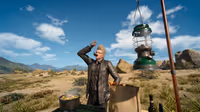
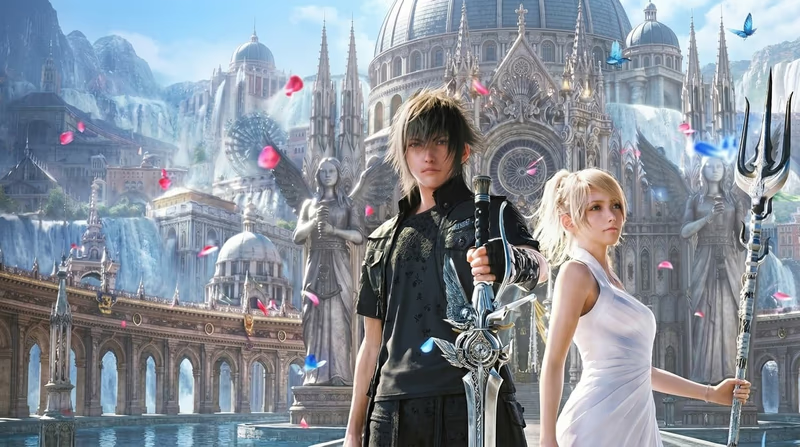
Noctis and his retinue cross Lucis in the Regalia, the heart of Final Fantasy XV's road-trip structure.

Final Fantasy XV spent a decade in development hell before it ever reached a disc. Announced in 2006 as Final Fantasy Versus XIII, the project outlived the console generation it was meant to launch on, shed its numeral, and emerged in November 2016 as something closer to a eulogy than a sequel. Director Hajime Tabata inherited a tangle of unfinished ideas from Tetsuya Nomura and had to cut, rebuild, and finish a game under a deadline the original vision never had. What shipped is unmistakably a Final Fantasy, but one built for an audience raised on open worlds and real-time combat rather than ATB gauges and random encounters.
The premise is small by series standards, and that's the point. Prince Noctis Lucis Caelum and three childhood friends, Gladiolus, Ignis, and Prompto, set out by car for his arranged wedding, only for the empire of Niflheim to raze his home kingdom of Insomnia behind him. The rest of the game is a road trip through grief, loyalty, and an inherited crown, told at the pace of four guys bickering over gas money and camp cooking rather than a chosen-one's forced march to save the world.
Lucis is the first truly open continent in the mainline series, and Square Enix built the whole game around getting there. The Regalia, Noctis's convertible, cruises fixed highways by default, slowing down for gas stations, diners, and the chocobo ranch at Wiz Chocobo Post, while manual driving only unlocks after enough story progress. It's a deliberately unhurried way to see the world. Radio stations loaded with classic Final Fantasy battle themes turn every long haul into a victory-lap mixtape for series veterans.
Camping ties the open world to its best mechanical idea: cook a meal at the right campsite and the party gets a stat buff for the whole next day, turning Ignis's recipe list into something worth planning around rather than flavor text. Side content ranges from throwaway fetch quests to the genuinely excellent hunts, bounty-board contracts to take down specific monsters like the towering Naga or the lightning-fast Iron Giant for gil and rare crafting materials. The hunts are where the open world earns its keep. Everything else sits somewhere between pleasant filler and padding.
Combat abandons turn order entirely. Noctis fights in real time with the Active Cross Battle system, holding one button to attack and another to warp-strike toward or away from enemies, teleporting in bursts that double as both offense and a dodge button with near-total invincibility frames. Phasing through a Red Giant's downward slash a half-second before it lands never stops feeling good, and warping to a cliffside ledge to reset a fight against a pack of Sabertusks is a legitimate tactical option, not just a visual flourish.
Where the system drags is depth beneath that surface. Link-strikes with Gladio, Ignis, and Prompto trigger from context prompts more than deliberate input, and a long stretch of the midgame rewards mashing the attack button over managing MP for warp-strikes and techniques. Chapter 13, infamous among players for stripping Noctis of his allies and his weapons for a slow crawl through a besieged Insomnia, is the clearest example of a combat system that works brilliantly with a full party and falls apart without one.
The four leads carry the game, and that's by design: Tabata's team reportedly referred to the project internally as a story about brotherhood before it was ever about saving a kingdom. Ignis plays the dry, overprotective tactician. Gladio is the blunt drill sergeant who forces Noctis to grow up. Prompto, the anxious photographer, snaps candid shots throughout every chapter, turning his in-game camera roll into an unexpectedly moving scrapbook of the journey. Chapter 9's trial for Noctis, shouldered largely by Gladio, reframes him from comic relief into the group's conscience.
Ardyn Izunia, the antagonist, is one of the series' best, a cheerfully theatrical chancellor whose motives recontextualize everything about the Lucian royal line once the full picture lands. The tragedy is that so much of that picture only arrived later, through the Episode Ardyn DLC and the Brotherhood anime, rather than in the base campaign. Lunafreya, Noctis's betrothed and the story's emotional center, suffers the worst from the cut content: her arc plays almost entirely offscreen, reduced to scattered letters and a handful of crucial but underexplained scenes.
Final Fantasy XV launched as a game visibly missing pieces, and Square Enix spent the following two years patching, DLC-ing, and re-cutting it into something closer to whole. A free day-one update added features cut for launch, and the Royal Edition and Windows Edition later folded in extra content natively. The planned Episode Duscae-style side stories for Gladio, Prompto, and Ignis shipped as paid DLC through 2017 and 2018, each filling gaps the main story left open, before Square Enix cancelled the remaining planned chapters (including one meant to show Lunafreya's perspective) in 2019.
That history matters because it's visible in the final product. The first two-thirds of the game luxuriate in open-world pacing, hunts, and camping banter. The last third compresses years of plot into a handful of corridors and cutscenes, visibly reshaped by a shrinking budget and timeline. Judged purely on what shipped, it's a gorgeous, mechanically satisfying game that never quite finishes telling its own story. Judged as the last mainline entry built on the old pre-Remake Square Enix pipeline, it's a fascinating, compromised artifact of a studio learning to let go of an overambitious decade-long dream.
Pros:
Cons:
Final Fantasy XV is a kingdom's worth of good ideas wearing the scars of the decade it took to build them. The road trip with Noctis's three closest friends remains one of the series' warmest, most human stories, and the warp-strike combat system still holds up as a confident reinvention of what a Final Fantasy battle can feel like in real time. But the game never fully recovers from the compromises forced on its final act, and its best material, Ardyn's full tragedy, Lunafreya's perspective, the chapters Square Enix never got to finish, lives scattered across DLC and tie-in media instead of the disc itself. It's a flawed, frequently beautiful send-off for an era of Final Fantasy, worth the trip even with the detours.

Affiliate link: Support the blog via Instant Gaming at no extra cost.
Final Fantasy XV
Others Posts
A new-player's guide to Final Fantasy XV: how to drive, hunt, cook, and fight your way across Lucis without wasting your first twenty hours on avoidable mistakes.
Lost Odyssey: Hironobu Sakaguchi's Xbox 360 epic, Nobuo Uematsu's soundtrack, turn-based tactical combat, and the emotional Thousand Years of Dreams.
BioWare's 2007 space opera Mass Effect fused third-person shooting with branching dialogue choices, launching the saga of Commander Shepard and the fight against the Reapers.
Rockstar San Diego's Red Dead Redemption traded Liberty City's skyline for the dying American frontier, delivering one of the finest open-world westerns ever made.
CD Projekt RED's 2007 debut adapted Andrzej Sapkowski's novels into a gritty, choice-driven RPG that put the fledgling studio on the map.
A newcomer's guide to Portal 2's controls, gel and funnel mechanics, and co-op basics - everything you need before Aperture Science starts testing you for real.
A practical, course-by-course guide to Super Mario 64 - how to navigate Peach's Castle, which Stars to chase first, and how to actually get all 120 without wasting hours on the ones that trip everyone up.
An engineering retrospective on the Nintendo Game Boy Color. We explore how a double-speed Sharp SM83 core, a backward-compatible palette-mapped color LCD, and translucent 'Atomic Purple' shells turned a stopgap handheld into the system that carried Pokémon's second generation.

Analysis of the PlayStation 4 and PS4 Pro hardware. We examine the shared CPU bottleneck, the mirrored butterfly GPU design, memory optimizations, and the hardware-level checkerboard rendering that enabled the 4K transition.
guides
Ten essential tips for starting Yakuza 0: managing early yen before Real Estate Royale and Cabaret Club Czar open up, navigating Kamurocho and Sotenbori without getting lost, and understanding the save system so you never lose progress.
