Gears of War Ultimate Edition
When Epic Games handed the keys to the Gears of War franchise over to Microsoft, the newly formed studio, The Coalition, had a massive point to prove.
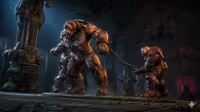

Image captured on Xbox 360

Does the Kilo Squad prequel ruin the franchise? We analyze Judgment's arcade campaign, controversial gunplay, and fragmented story structure.
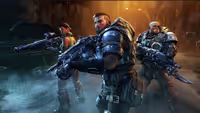
Epic Games handed the keys to People Can Fly, resulting in the most divisive title in Xbox 360 history. Gears of War: Judgment is a prequel that steps away from Marcus Fenix to put Damon Baird and Cole Train in the spotlight.
It landed at the end of a console generation, attempting to inject raw arcade adrenaline into a purely tactical franchise. The result is a campaign that feels completely alien to the heavy, emotional tone of the original trilogy.
It is a bold experiment, but one that actively alienates the hardcore fanbase.
The plot ditches the traditional linear journey. Instead, Kilo Squad is on trial for treason, and the entire campaign plays out through their individual testimonies to a military tribunal.
This narrative choice completely shatters the immersive pacing. You are not experiencing a seamless war epic; you are playing disconnected, bite-sized arena segments that end with a jarring arcade scorecard.
It destroys the atmospheric tension. You clear a room, check your star rating, and wait for the next wave of Locust to spawn. The story takes a backseat to chasing high scores.
To fix the fragmented story, the developers introduced Declassified Missions. Activating these modifiers alters the squad's testimony, adding brutal restrictions like reduced visibility, time limits, or locked loadouts.
This is where the campaign actually shines. It turns standard firefights into frantic survival puzzles that challenge your muscle memory and force you to adapt.
Coupled with the dynamic Smart Spawn System, you cannot memorize enemy positions. If you die, the game might swap out standard grunts for a heavily armored Boomer that acts like a massive bullet sponge, demanding a completely new strategy.
People Can Fly stripped the heavy, grounded feel out of the franchise. They mapped weapon swapping to the Y button, forcing a restrictive loadout that enraged purists and ruined decades of tactical muscle memory.
The gunplay is much faster, encouraging you to rush enemy positions aggressively rather than flanking them from cover. The tight hitboxes reward twitch reflexes over calculated positioning.
The technical side suffered under this chaotic pace. When the screen fills with enemies, heavy frame drops and nasty stutters break the immersion, though input lag remains surprisingly low during the chaos.
Pros:
Cons:
Judgment is not a terrible video game, but it is a highly flawed Gears campaign. It sacrificed the heavy, desperate atmosphere of Sera in favor of fast-paced, arcade action.
If you treat it as a high-score chaser rather than a cinematic war story, the frantic combat loops are genuinely fun. Just do not expect the dark narrative depth that made this franchise legendary.

Affiliate link: Support the blog via Instant Gaming at no extra cost.
Others Posts
When Epic Games handed the keys to the Gears of War franchise over to Microsoft, the newly formed studio, The Coalition, had a massive point to prove.
Discover the core story without spoilers, the exact chronological order to play the franchise, and which modern platforms to find them on.

Is Crysis just a hardware-melting benchmark or a genuine FPS masterpiece? We analyze CryEngine 2, Nanosuit mechanics, destructible physics, and the controversial Ceph shift.
Rare's stunning Xbox graphics, the controversial censorship cuts, and the shift to class-based online war.

The prequel that lets you slaughter humans as General RAAM using Gears 3's polished engine. Pure gore, heavy lore, and zero regrets.

Gears Tactics: Splash Damage's aggressive turn-based adaptation of Gears of War, the execution mechanic, and the hunt for Ukkon.