Red Dead Redemption Review: The Western That Redefined Open-World Gaming
Rockstar San Diego's Red Dead Redemption traded Liberty City's skyline for the dying American frontier, delivering one of the finest open-world westerns ever made.
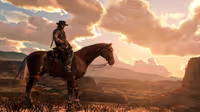
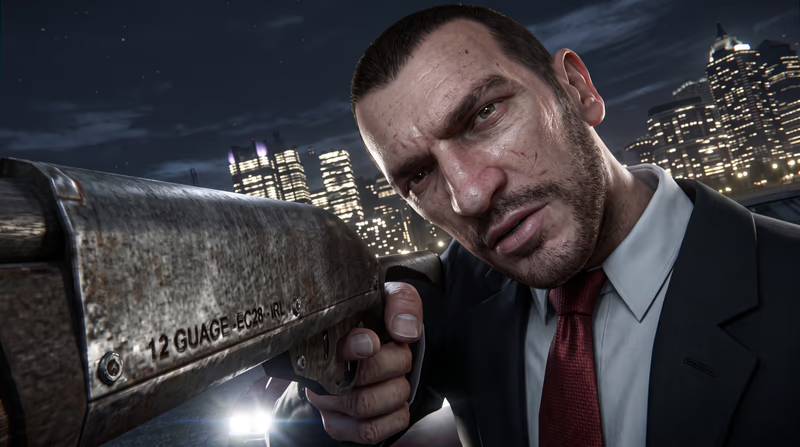
Liberty City at golden hour, rendered in Rockstar's RAGE engine.

By 2008, the Grand Theft Auto series had spent three console generations perfecting cartoonish chaos. Then Rockstar North dropped Niko Bellic into Liberty City and asked players to sit with the hangover instead. Grand Theft Auto IV: The Complete Edition folds that original campaign together with both stand-alone expansions, The Lost and Damned and The Ballad of Gay Tony, into a single package that still reads as Rockstar's most emotionally serious open-world game. The RAGE engine and Euphoria physics middleware gave the studio tools it had never had before: ragdolls that reacted to a bullet's actual trajectory, a city lit by a genuine day-night cycle, and a protagonist whose face could hold a silence. None of it feels quaint. It feels like the moment Rockstar decided crime stories could carry real weight.
Liberty City is GTA IV's real main character, modeled loosely on New York but compressed into something walkable in a way the five boroughs never are. Broker's crumbling brownstones give way to Algonquin's glass towers, and the Statue of Happiness stands watch over the harbor like a joke Rockstar never quite finishes telling.
The city doesn't just look dense. It behaves like a place people actually live in, which makes every mission that tears through it feel like a genuine intrusion rather than a sandbox toy being knocked over.
Niko isn't chasing a car collection or a mansion. He's an Eastern European war veteran who crossed an ocean on a lie, and the game never lets you forget it. His cousin Roman's gambling debts, his search for the man who betrayed his unit, and his slow realization that Liberty City just recycles the same violence he fled, all of it gives GTA IV a spine that earlier entries deliberately avoided.
Rockstar wrote a tragedy and wrapped a sandbox game around it, and the friction between those two instincts is exactly what makes the campaign memorable years later.
The Complete Edition's real value proposition sits in its two expansions, each reusing Liberty City's map to tell a completely different kind of story. The Lost and Damned trades Niko's immigrant-outsider arc for Johnny Klebitz's slow unraveling inside the Alderney biker gang, all road-worn leather and betrayal among men who call each other brothers. The Ballad of Gay Tony swings hard in the other direction, dropping Luis Lopez into the neon excess of nightclub ownership, where helicopter chases and Italian mob hits share screen time with velvet-rope drama.
Buying the bundle isn't a compromise. It's the format GTA IV was always meant to be experienced in.
GTA IV's mechanical systems were a deliberate step back from pure arcade handling, and that choice still divides players. Vehicles have real weight now: the Infernus still screams down the FDR Drive, but it also understeers into a guardrail if you treat a corner carelessly. Combat relies on a cover system borrowed from the era's third-person shooters, clunkier than Gears of War's but functional once muscle memory sets in.
None of these systems are flashy by modern standards, but together they gave Rockstar's open world a physical honesty that Vice City and San Andreas never attempted.
Pros:
Cons:
Grand Theft Auto IV: The Complete Edition isn't the series' most purely fun entry, San Andreas still wins that argument on scale and absurdity alone. It's the entry that proved Rockstar could make a crime story that actually hurt, then backed that ambition with two expansions sharp enough to stand on their own. Niko's tragedy, Johnny's loyalty, and Luis's glitter all point at the same bruised city from different angles, and together they make Liberty City one of the most convincingly lived-in places Rockstar has ever built.

Affiliate link: Support the blog via Instant Gaming at no extra cost.
Grand Theft Auto IV: The Complete Edition
Others Posts
Rockstar San Diego's Red Dead Redemption traded Liberty City's skyline for the dying American frontier, delivering one of the finest open-world westerns ever made.
Jason Brody's descent into hell, Vaas Montenegro's overwhelming charisma, and the formula that redefined Ubisoft forever.
Warhorse Studios' 2018 debut swapped fantasy tropes for obsessively researched medieval Bohemia, building one of the most punishing and rewarding RPGs of its generation.
Reevaluating Hideo Kojima's deeply divisive delivery simulator, a game whose themes of isolation, fractured societies, and the desperate need for connection became an eerie reality just months after its original release.

A practical beginner's guide to Grand Theft Auto IV: The Complete Edition, covering early money-making, which weapons and vehicles to prioritize, and how to approach the bundled Episodes from Liberty City content.
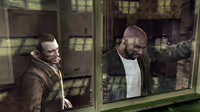
Grand Theft Auto: San Andreas sent CJ across three fictional cities and an entire state, building the biggest, most ambitious open world of the PS2 era.
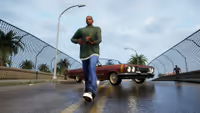

A newcomer's guide to Portal 2's controls, gel and funnel mechanics, and co-op basics - everything you need before Aperture Science starts testing you for real.

A practical, course-by-course guide to Super Mario 64 - how to navigate Peach's Castle, which Stars to chase first, and how to actually get all 120 without wasting hours on the ones that trip everyone up.

An engineering retrospective on the Nintendo Game Boy Color. We explore how a double-speed Sharp SM83 core, a backward-compatible palette-mapped color LCD, and translucent 'Atomic Purple' shells turned a stopgap handheld into the system that carried Pokémon's second generation.

Analysis of the PlayStation 4 and PS4 Pro hardware. We examine the shared CPU bottleneck, the mirrored butterfly GPU design, memory optimizations, and the hardware-level checkerboard rendering that enabled the 4K transition.
guides
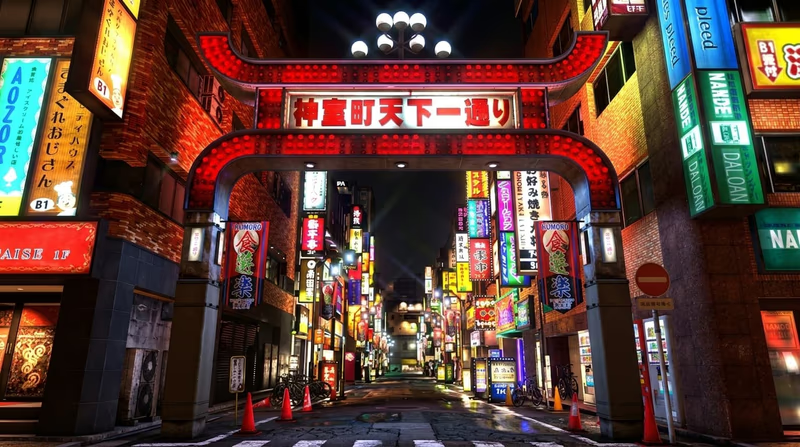
Ten essential tips for starting Yakuza 0: managing early yen before Real Estate Royale and Cabaret Club Czar open up, navigating Kamurocho and Sotenbori without getting lost, and understanding the save system so you never lose progress.
