Alan Wake Remastered: A Nightmare Brought to Light
How Remedy Entertainment's psychological thriller uses the power of light and the tropes of classic horror literature to craft an unforgettable, modernized nightmare in Bright Falls.

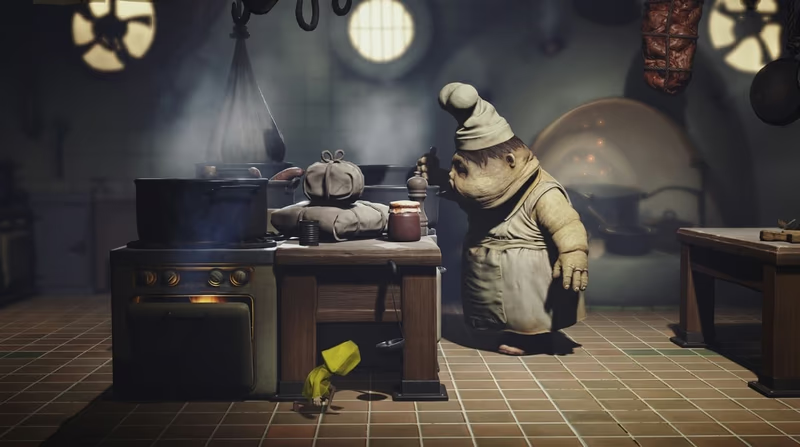
Six creeps past towering, gluttonous chefs in The Maw's nightmarish kitchen.

Six wakes up in a leaking cabin, soaked through a yellow raincoat several sizes too big, with no memory of how she got there and no voice to ask why. Tarsier Studios built an entire game around that disorientation. Little Nightmares, released in April 2017 for PS4, Xbox One, and PC (with a Switch port following in 2018), swapped the jump-scare theatrics that define most horror games for something quieter and far more unsettling: a world where every doorknob is out of reach and every adult is a grotesque.
The setup is simple. Six must escape The Maw, a rusting, half-submerged vessel that functions as a floating slaughterhouse for the obese, snuffling creatures who run it. There's no dialogue, no tutorial text, barely a UI. The game trusts its environment to explain itself, and that confidence pays off in a four-to-five-hour experience that lingers far longer than its runtime suggests.
Every room in The Maw is a trap disguised as furniture. Kitchen counters tower overhead like cliff faces. Door handles sit at the height of a grown man's shoulder, forcing Six to drag chairs, climb drawers, and lunge for ledges that barely hold her fingertips. Tarsier's trueSKY-free, hand-tuned lighting work carves every corridor into pools of warm lamp-glow surrounded by suffocating dark, and the camera's fixed, slightly tilted angles do the rest of the psychological work without a single line of exposition.
This is forced perspective as game design, not just art direction. The scale differential between Six and everything around her isn't a visual flourish—it's the entire mechanical language of the game. A pursuing chef doesn't need six close-up shots of teeth to be terrifying when his silhouette alone blots out three-quarters of the screen.
Little Nightmares alternates between two registers: patient physics-puzzle platforming and frantic, scripted chase sequences. The puzzle stretches ask you to stack crates, time a swinging chandelier, or coax a lever-operated door open while nothing is actively hunting you. Then, without warning, the Janitor's impossibly long arms snake around a corner and the game drops into pure survival mode—sprint, duck, slide under a gap before those hands close around your throat.
The pacing works because neither mode overstays its welcome. A sustained chase against the Janitor, blind and hunting purely by sound, turns Six's footsteps into a genuine liability—tiptoe past a creaking floorboard and the dread compounds with every step. Compare that to the Twin Chefs sequence, which trades stealth tension for slapstick horror as two bloated cooks lumber after Six through an industrial kitchen stacked with meat hooks and boiling pots. Few games this short manage so many distinct flavors of fear without repeating a beat.
Nothing in The Maw speaks a human word, and the game is better for it. Composer Tobias Lilja's score surfaces only in flashes—a single sustained string note when a threat spots you, silence otherwise—leaving ambient creaks, drips, and distant screeching to carry the atmosphere. That restraint makes the rare musical stings land like gut punches.
Visually, Tarsier leaned into a storybook-grotesque aesthetic: soft, almost plush character models wrapped in muted, sepia-toned environments that make the occasional splash of red or yellow (Six's raincoat chief among them) pop with real menace. It's a deliberate inversion of horror's usual visual grammar, swapping harsh reds and sickly greens for a palette that looks cozy until you notice what's hanging from the ceiling.
Pros:
Cons:
Little Nightmares doesn't need a monster with too many teeth to unsettle you—it needs a doorknob you can't reach and a floorboard that creaks at the worst possible moment. Tarsier Studios proved that horror built from scale, silence, and a child's vulnerability can out-tension games with ten times the budget and a dozen more jump scares. It's a short, nasty, beautifully constructed nightmare, and one of the finest horror-adjacent games of its console generation.

Affiliate link: Support the blog via Instant Gaming at no extra cost.
Little Nightmares
Others Posts
How Remedy Entertainment's psychological thriller uses the power of light and the tropes of classic horror literature to craft an unforgettable, modernized nightmare in Bright Falls.
How to Master Combat, Weapons, and the Secrets of Alan Wake Remastered. Golden Rule: Light is your shield, and bullets are your sword.
Capcom's remake of Resident Evil 3 trades Nemesis's slow dread for a sprint, delivering a tighter, more action-driven nightmare that burns bright but doesn't last long.
Shadow of the Colossus: Fumito Ueda's timeless journey, its lonely world, Wander's tragic quest, and the majesty of the 16 colossi.
The Order: 1886 transports us to a beautifully grim, smog-choked 19th-century London. But this is not the London of Charles Dickens; it's a battleground.

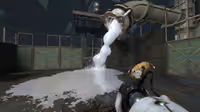
A newcomer's guide to Portal 2's controls, gel and funnel mechanics, and co-op basics - everything you need before Aperture Science starts testing you for real.
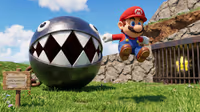
A practical, course-by-course guide to Super Mario 64 - how to navigate Peach's Castle, which Stars to chase first, and how to actually get all 120 without wasting hours on the ones that trip everyone up.
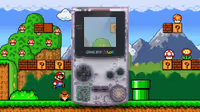
An engineering retrospective on the Nintendo Game Boy Color. We explore how a double-speed Sharp SM83 core, a backward-compatible palette-mapped color LCD, and translucent 'Atomic Purple' shells turned a stopgap handheld into the system that carried Pokémon's second generation.

Analysis of the PlayStation 4 and PS4 Pro hardware. We examine the shared CPU bottleneck, the mirrored butterfly GPU design, memory optimizations, and the hardware-level checkerboard rendering that enabled the 4K transition.
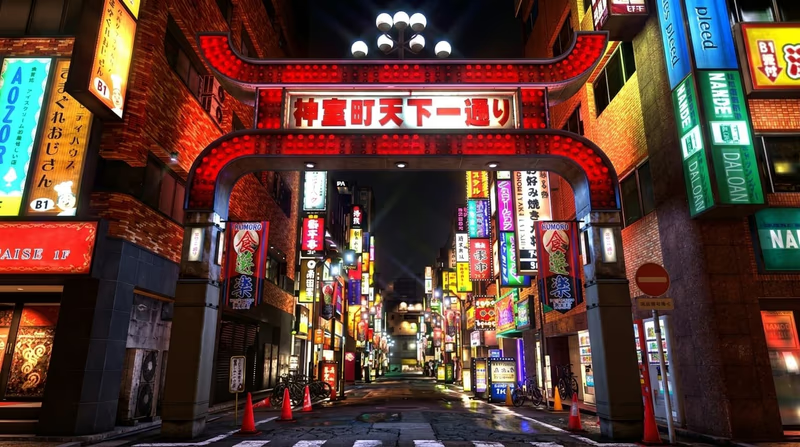
guides
Ten essential tips for starting Yakuza 0: managing early yen before Real Estate Royale and Cabaret Club Czar open up, navigating Kamurocho and Sotenbori without getting lost, and understanding the save system so you never lose progress.
