Half-Life 2: The Crowbar That Shifted the Tides of Gaming History
Two decades later, Valve’s magnum opus remains the undisputed gold standard for first-person shooters and a towering legend in the interactive medium.
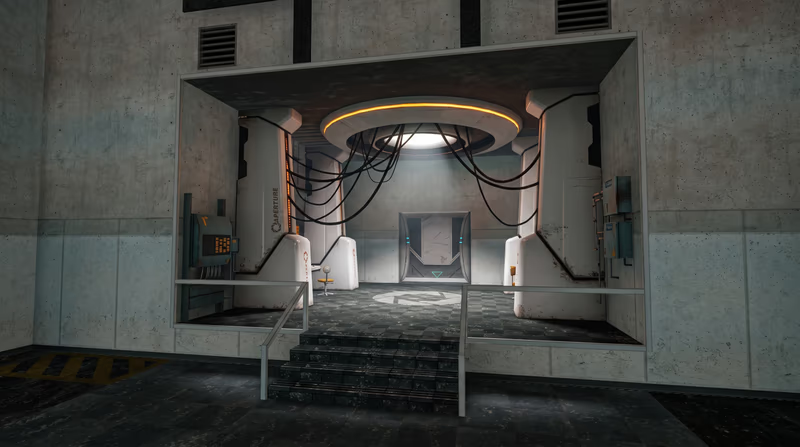
Portal, Valve Corporation, 2007
Valve buried Portal inside The Orange Box like a footnote. Half-Life 2: Episode Two was the marquee release, Team Fortress 2 was the one everyone argued about on forums, and this short, strange puzzle game built by a handful of former DigiPen students was the bundle's wildcard. It launched October 10, 2007, ran on the same Source engine as the rest of the box, and within weeks had eclipsed both of its heavyweight siblings in cultural footprint. Nobody saw that coming, least of all Valve.
The premise is almost insultingly simple: you hold a gun that doesn't fire bullets, it fires holes. Shoot one portal on a wall, another portal on a different wall, and anything that walks through one comes out the other, momentum intact. Aperture Science calls this the Aperture Science Handheld Portal Device. Everyone else just calls it the portal gun, and it remains one of the few single-mechanic ideas in game design that genuinely earns the word elegant.
What makes the portal gun work isn't the physics trick itself, it's how ruthlessly Valve paces the player's understanding of it. Chell starts with a device that can only open one type of portal, locked to a wall that's already been scorched orange and blue in previous tests. The early chambers teach geometry: line up two portals, walk through, done. By chamber eleven you're redirecting your own momentum through a portal on the floor to launch yourself across a chasm you have no business clearing.
By the test chamber where you first glimpse the maintenance tunnels behind the pristine white walls, the game has already rewired how you look at every room: not as a space to walk through, but as two surfaces waiting for holes.
Ellen McLain's voice work as GLaDOS carries the entire back half of the campaign. She's dry, clinical, and lethal in a way that never raises its pitch. The genius of the writing, credited to Erik Wolpaw and Chet Faliszek, is restraint: GLaDOS doesn't monologue about her evil plan, she administers a test protocol, and the horror creeps in through what she treats as routine. Promises of cake delivered in the same flat tone as safety disclaimers. A "this next test will likely result in your death" dropped as casually as a weather report.
The escape from the testing track, where the environment flips from sterile enamel to exposed concrete and rusted pipe, is the moment Portal stops being a puzzle game and becomes something closer to a thriller. You're not solving chambers anymore, you're running from a building that wants you dead, and the portal gun becomes a survival tool instead of a toy. Few games manage a tonal pivot this sharp without losing the thread of what made the first half work.
Portal's test chambers escalate in roughly nineteen stages, and the design never pads itself. There's no chamber here that exists purely to extend the runtime, every single one introduces, combines, or stress-tests a mechanic the player hasn't fully internalized yet. Compare that to most puzzle games of the era, which front-load their best ideas and spend the back third recombining them without variation. Portal does the opposite: its hardest, most inventive chambers sit right before the GLaDOS confrontation, when the player is finally fluent enough in portal logic to appreciate them.
A three-to-five-hour campaign sounds thin on paper next to the forty-hour open worlds crowding shelves that same year. It isn't. Portal is exactly as long as its ideas last, and not one minute longer, which is rarer in this industry than it should be.
The story Portal tells, it tells almost entirely through environmental debris. Scrawled graffiti in the maintenance tunnels, warning the next test subject in increasingly unhinged handwriting, does more worldbuilding than most games manage in hours of cutscenes. Chell herself never speaks a single line, and the choice works precisely because GLaDOS fills every silence with enough personality for two characters.
The dark comedy lands because it's underplayed. A cake that may or may not exist becomes a meme the internet still hasn't let go of, nearly two decades later, not because it's a punchline but because of how matter-of-factly GLaDOS dangles it. That restraint is the whole trick: Portal never winks at the camera, it just lets the absurdity of being murdered by a passive-aggressive supercomputer speak for itself.
Pros:
Cons:
Portal didn't need to be long, loud, or technically ambitious to become one of the defining games of its decade. It needed one idea, executed with a precision that still humbles puzzle design almost twenty years later, and a villain whose flat, polite menace outlasted entire console generations in the cultural memory. Valve buried this one in a bundle as an afterthought. It walked out the other side of that portal as the main event.

Affiliate link: Support the blog via Instant Gaming at no extra cost.
Portal
Others Posts
Two decades later, Valve’s magnum opus remains the undisputed gold standard for first-person shooters and a towering legend in the interactive medium.
Two decades after their release, the episodic additions to Half-Life 2 stand as some of Valve's finest work, showcasing brilliant cooperative AI and stunning environmental design—yet they remain forever haunted by a single, agonizing cliffhanger.
BioShock dropped players into Rapture, a drowned utopia gone to ruin, and fused first-person shooting with RPG-lite choice to become one of the defining games of its generation.
Reevaluating Hideo Kojima's deeply divisive delivery simulator, a game whose themes of isolation, fractured societies, and the desperate need for connection became an eerie reality just months after its original release.

A newcomer's guide to Portal 2's controls, gel and funnel mechanics, and co-op basics - everything you need before Aperture Science starts testing you for real.
A practical, course-by-course guide to Super Mario 64 - how to navigate Peach's Castle, which Stars to chase first, and how to actually get all 120 without wasting hours on the ones that trip everyone up.
An engineering retrospective on the Nintendo Game Boy Color. We explore how a double-speed Sharp SM83 core, a backward-compatible palette-mapped color LCD, and translucent 'Atomic Purple' shells turned a stopgap handheld into the system that carried Pokémon's second generation.

Analysis of the PlayStation 4 and PS4 Pro hardware. We examine the shared CPU bottleneck, the mirrored butterfly GPU design, memory optimizations, and the hardware-level checkerboard rendering that enabled the 4K transition.
guides
Ten essential tips for starting Yakuza 0: managing early yen before Real Estate Royale and Cabaret Club Czar open up, navigating Kamurocho and Sotenbori without getting lost, and understanding the save system so you never lose progress.
