How to Unlock the Alto Card in Super Mario RPG
A step-by-step guide to solving Toadofsky's first musical puzzle at Tadpole Pond, earning the Alto Card, and unlocking powerful party-wide healing items at the Juice Bar.

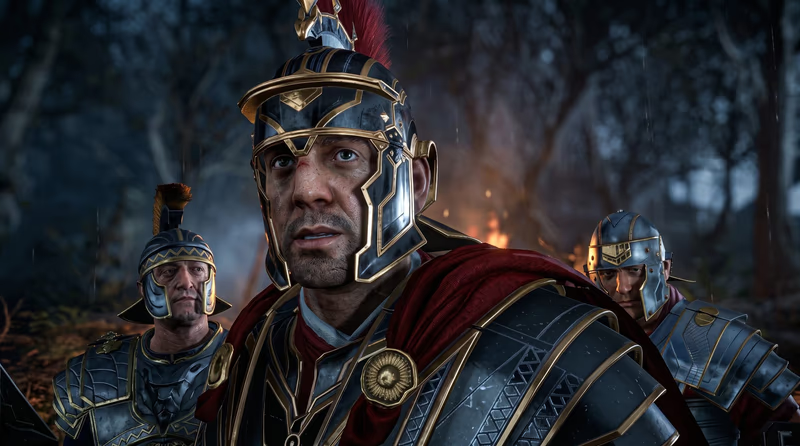
Image captured on Xbox Series X and retouched with Nano Banana.

When Microsoft launched the Xbox One in 2013, they needed a title that immediately demonstrated the raw processing power of new hardware. They turned to Crytek—the legendary visual wizards behind Crysis—and the result was Ryse: Son of Rome.
Serving as a grand technical statement, Ryse traded sci-fi nanosuits for the blood-soaked armor of the Roman legions.
It told the visceral, tragic tale of Marius Titus, a young soldier rising through the ranks of the Roman military on a quest to avenge his slaughtered family while uncovering deep political corruption at the heart of the Empire.
Visually, Ryse: Son of Rome was nothing short of a masterpiece that easily held its ground against games released years later.
Powered by CryEngine, the game delivered movie-quality facial capture, hyper-detailed armor textures that gleamed in sunlight, and stunning volumetric lighting. From the rain-slicked, tribal forests of Britannia to the roaring crowds of the Roman Colosseum, every environment looked like a big-budget Hollywood epic in the vein of Gladiator.
Supported by brutal sound design—where every sword clash, shield bash, and bone-crunching impact reverberated with weight—it delivered an immersive cinematic atmosphere rarely matched during the eighth console generation.
While the presentation was breathtaking, the underlying gameplay mechanics received a far more mixed reception.
At its core, Ryse operates as a hack-and-slash action game focused on timing:
The most controversial element was the execution system. Once an enemy’s health depleted, a button prompt triggered a color-coded Quick Time Event (QTE) execution.
While these executions were gloriously gory and offered selectable buffs (health regeneration, bonus damage, or extra experience points), they required minimal execution skill. The game allowed players to complete the kill even if they missed the button prompt, making combat feel heavily automated and repetitive over time.
Additionally, periodic sections featured Marius commanding his cohort in a testudo (turtle) shield formation to advance under rains of enemy arrows, offering brief tactical breaks from standard melee fights.
Beyond the cinematic story mode, Ryse featured a cooperative multiplayer Gladiator mode set inside a dynamic Roman Colosseum.
Two players could team up to fight off endless waves of enemies while the arena floor shifted mechanically between rounds—introducing hazards, traps, and new terrain objectives.
While entertaining in short bursts, the multiplayer shared the exact same combat mechanics as the single-player game. Combined with a short story campaign spanning roughly 6 to 7 hours, the title lacked long-term replay value.
Pros:
Cons:
Ryse: Son of Rome is a glorious, blood-soaked cinematic roller coaster. While it prioritized breathtaking visual spectacle over deep hack-and-slash mechanics, Crytek succeeded in creating an unforgettable showcase of technical power.
If you are looking for an action-packed, short-and-sweet Roman epic that still looks better than many modern releases, Ryse remains well worth experiencing.

Affiliate link: Support the blog via Instant Gaming at no extra cost.
Ryse: Son of Rome
Others Posts
A step-by-step guide to solving Toadofsky's first musical puzzle at Tadpole Pond, earning the Alto Card, and unlocking powerful party-wide healing items at the Juice Bar.
Is Crysis just a hardware-melting benchmark or a genuine FPS masterpiece? We analyze CryEngine 2, Nanosuit mechanics, destructible physics, and the controversial Ceph shift.

This field manual deconstructs the primary bosses of the campaign, offering precise tactical analysis to dismantle them piece by heavy-metal piece.

Master Lost Odyssey's Skill Link system, Aim Ring timing, Guard Condition, and early difficulty spikes with our ultimate beginner's guide.

We explore how Nintendo dominated the 16-bit console war not through sheer CPU speed, but through a masterful integration of custom audio-visual processors, revolutionary controller ergonomics, and an ingenious strategy of in-cartridge hardware expansion.

Build the ultimate Wasteland 2 squad. We rank the best recruits in Arizona and LA, explain stats evolution, and list the most essential skills for smooth progression.

Are the Minecraft Dungeons DLCs worth buying? We break down all 6 expansions, their biomes, unique mechanics, boss fights, and rank the absolute must-haves.

Master turn-based combat in Gears Tactics. Learn to chain executions for infinite Action Points, optimize class builds, and crush colossal bosses.

Analysis of the PlayStation 4 and PS4 Pro hardware. We examine the shared CPU bottleneck, the mirrored butterfly GPU design, memory optimizations, and the hardware-level checkerboard rendering that enabled the 4K transition.

PlayStation 5 Pro hardware: PSSR, Advanced Ray Tracing, and the AI Revolution. We analyze Sony's PlayStation Spectral Super Resolution (PSSR), RDNA 4 Ray Tracing advancements, and the engineering behind the end of the Fidelity vs. Performance compromise.
guides
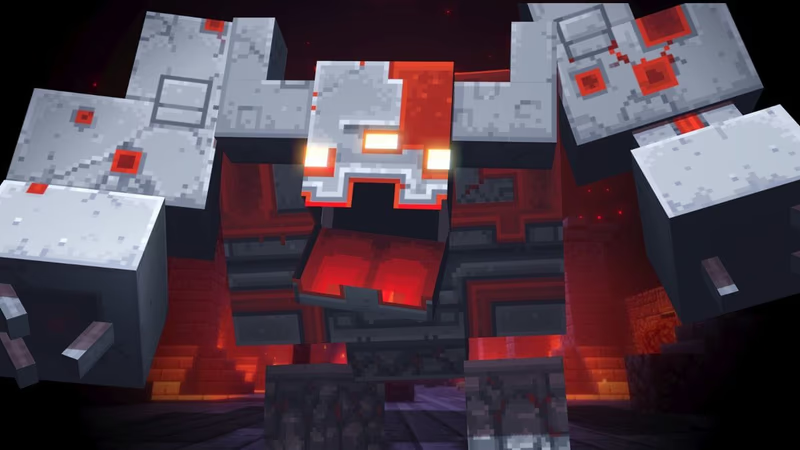
Conquer the toughest bosses in Minecraft Dungeons. Master attack patterns, exploit weak points, and equip the best builds for every major fight.
