StarCraft Beginner's Guide: Core Strategy for New Commanders
New to StarCraft? Learn how to pick a faction, build a solid economy, and avoid the mistakes that get new commanders overrun in their first ladder matches.
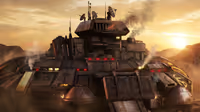
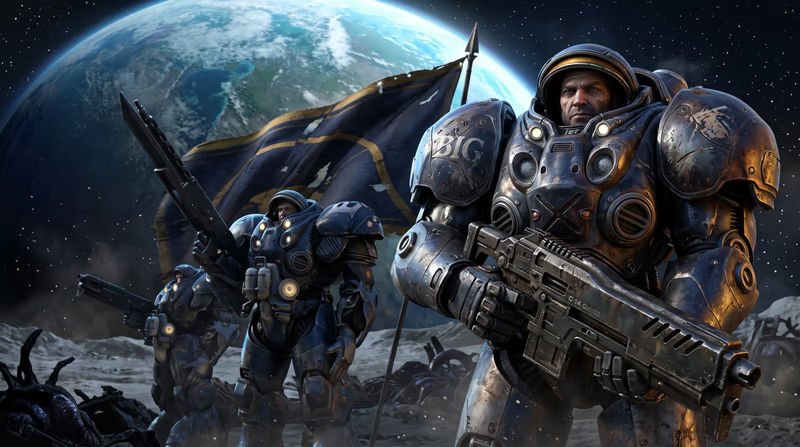
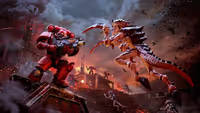
StarCraft – Terran vs. Protoss Battle Artwork
Blizzard's pitch for StarCraft started as something far less ambitious: take the Warcraft II engine, swap orcs and humans for a space opera, and ship a sequel-adjacent cash-in before anyone noticed the reuse. The first build, shown at E3 1996, looked exactly like that, Warcraft units with a coat of sci-fi paint, and the response was brutal enough that Blizzard scrapped nearly two years of work and started over.
What emerged in March 1998 wasn't a reskin. It was a real-time strategy game built around a single, uncompromising design rule: three factions, zero shared units, and a balance so tight that professional players would still be arguing over matchup theory two decades later.
Most RTS games before StarCraft gave each side the same toolkit with different skins. Blizzard threw that convention out entirely.
The single-player story takes the asymmetry seriously instead of treating it as a multiplayer-only gimmick.
StarCraft launched alongside Blizzard's free Battle.net service, and the two were built to feed each other.
No single market embraced StarCraft like South Korea, and the effect reshaped the entire games industry.
Pros:
Cons:
StarCraft is the rare strategy game whose influence outgrew the genre itself, spawning a professional sports industry on the strength of three factions that never stopped being fair to compete against. Blizzard's decision to scrap an entire Warcraft-reskin prototype and rebuild from scratch is the reason the game still gets studied by competitive players today. Few RTS titles since have matched its balance, and none have matched what it built around it.

Affiliate link: Support the blog via Instant Gaming at no extra cost.
StarCraft
Others Posts
New to StarCraft? Learn how to pick a faction, build a solid economy, and avoid the mistakes that get new commanders overrun in their first ladder matches.
Ensemble Studios proved RTS games can thrive on a gamepad. We analyze Halo Wars: Definitive Edition’s 60 FPS performance, Blur cutscenes, and UNSC lore.
Black Lab Games brought Warhammer 40k's tabletop wargame to life with grid-based tactics, blood-soaked executions, and the aggressive Momentum system.
Gears Tactics: Splash Damage's aggressive turn-based adaptation of Gears of War, the execution mechanic, and the hunt for Ukkon.
A newcomer's guide to Portal 2's controls, gel and funnel mechanics, and co-op basics - everything you need before Aperture Science starts testing you for real.
A practical, course-by-course guide to Super Mario 64 - how to navigate Peach's Castle, which Stars to chase first, and how to actually get all 120 without wasting hours on the ones that trip everyone up.
An engineering retrospective on the Nintendo Game Boy Color. We explore how a double-speed Sharp SM83 core, a backward-compatible palette-mapped color LCD, and translucent 'Atomic Purple' shells turned a stopgap handheld into the system that carried Pokémon's second generation.

Analysis of the PlayStation 4 and PS4 Pro hardware. We examine the shared CPU bottleneck, the mirrored butterfly GPU design, memory optimizations, and the hardware-level checkerboard rendering that enabled the 4K transition.

guides
Ten essential tips for starting Yakuza 0: managing early yen before Real Estate Royale and Cabaret Club Czar open up, navigating Kamurocho and Sotenbori without getting lost, and understanding the save system so you never lose progress.
