Introduction
Nintendo had one job on June 23, 1996: prove that a joystick with an analog nub in the middle could do something a D-pad never could. Super Mario 64 didn't just prove it. It handed every developer who came after a blueprint for how to move a character through three dimensions, and most of them are still copying homework from a cartridge that shipped alongside the console itself. Mario had spent a decade mastering two axes of movement. Here, Nintendo EAD throws him into a sandbox with none of the old rules and somehow makes the transition feel inevitable rather than experimental.
The setup barely matters, which is the point. Princess Peach bakes a cake, invites Mario over, and Bowser beats him to the castle, sealing the Power Stars behind paintings that double as doorways into other worlds. What matters is what happens the second you step into that courtyard and realize you can walk in a full circle around a tree, climb it, and leap off at an angle nobody told you was possible.
A Castle as a Hub World
Peach's Castle is the quiet genius nobody talks about enough. Instead of a level-select screen, Nintendo built a physical space you walk through to reach stages, and that single decision turns loading into exploration. Paintings on the walls lead to Bob-omb Battlefield, Whomp's Fortress, Jolly Roger Bay, and a dozen others, each one a self-contained diorama you revisit three or four times for different Stars rather than clearing once and discarding.
- Non-linear progression: you need only 70 of the game's 120 Stars to reach Bowser's final fight, so a player stuck on one course can simply go find Stars somewhere else.
- Secret stars woven into the hub itself: the castle holds Stars that have nothing to do with any painting, rewarding players who poke at the building instead of rushing past it.
- Vertical staging: the castle's basement, main floor, and upper towers gate content behind Star counts, pacing the back half of the game without a single cutscene telling you to wait.
The hub never feels like scaffolding. It feels like a place, and that's what let later games — Banjo-Kazooie, Spyro, even Mario's own Odyssey decades on — treat a central space as a character in its own right rather than a menu with extra steps.
The Camera Problem, Solved
Every 3D game before this one had its camera nailed to a rail or bolted directly behind the character's head, and both approaches broke constantly. Nintendo's answer was Lakitu, the cloud-riding Koopa who literally follows Mario with a camera and lets the player nudge his framing with the C-buttons. It's a cheeky, diegetic fix for a problem the entire industry was flailing at, and it's imperfect by design — tight corridors and awkward corners still fight you.
That friction is honest rather than broken. The camera struggles exactly where a human cameraman would struggle: pressed into a tight cave, chasing Mario up a spinning tower, or trying to frame a boss fight on a tilting platform. Nintendo didn't solve 3D cameras so much as admit the problem out loud and build a character around admitting it, which is a smarter move than pretending the issue away.
Analog Control and the Triple Jump
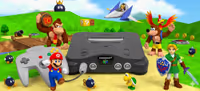
The N64 controller's analog stick gets Mario moving at any speed and in any direction the player's thumb dictates, and the moveset built on top of it is still the gold standard for character-action platforming. A standing jump chains into a running jump chains into a triple jump that launches Mario absurdly high, and chaining it correctly feels like discovering a secret rather than reading a tutorial prompt.
- The long jump: a crouch-dive that eats horizontal distance faster than any other move, essential for skipping sections of a level entirely.
- The wall kick: a precision bounce between two surfaces that turns narrow shafts into climbable puzzles instead of dead ends.
- The ground pound: a stomp with actual weight behind it, used for breaking blocks, crushing switches, and punishing enemies from above.
- Swimming and flying caps: the Vanish Cap, Metal Cap, and Wing Cap each rewrite Mario's entire moveset for a limited stretch, and the Wing Cap stages remain some of the most purely joyful flight sequences Nintendo has ever built.
Hold all of that together with analog precision and you get a character who feels responsive at every speed, from a careful tiptoe along a thin beam to a full sprint off a cliff edge.
Level Design Without a Straight Line
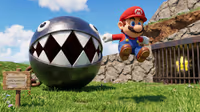
Super Mario 2D games pointed you right and dared you to survive the trip. Super Mario 64 drops you in the middle of Bob-omb Battlefield and lets you decide whether the first Star you grab is at the mountain's peak, inside the Chain Chomp's fenced yard, or buried in a race against Koopa the Quick. Six different Stars, one shared space, zero hand-holding about which to chase first.
That structure holds across the whole game. Tick Tock Clock turns the literal passage of time into a platforming mechanic you can speed up or slow down. Tall, Tall Mountain rewards a reckless slide down its slopes as much as a careful climb up them. Rainbow Ride strings floating carpets over a bottomless void and trusts the player's grasp of momentum from twelve stages earlier. Nothing here is padding. Every course earns its real estate by asking a genuinely different question about how Mario moves.
Pros and Cons
Pros:
- A control scheme that still holds up: the analog-driven moveset feels precise enough that modern platformers are judged against it, not the other way around.
- Courses built for replay, not completion: six or seven Stars per level means every return trip through a familiar space uncovers something new.
- Koji Kondo's score: the Bob-omb Battlefield theme and the underwater Dire, Dire Docks cue remain two of the most recognizable pieces of music the medium has produced.
- A hub world that earns its keep: Peach's Castle turns navigation into discovery instead of a loading screen with extra steps.
Cons:
- The camera still fights back: Lakitu's framing buckles in cramped interiors and during a handful of boss fights, and no amount of nostalgia erases the frustration of a blind fall.
- Hit detection on some jumps feels dated: precision platforming over bottomless pits occasionally punishes inputs that look correct on screen.
- The 100-coin Stars run long: several late-game coin hunts stretch a course's welcome well past the point where its secrets have been exhausted.
Conclusion
Three decades on, Super Mario 64 hasn't aged into a curiosity you tolerate for historical reasons. It's aged into a baseline, the game every 3D platformer since has been quietly measured against whether its designers admit it or not. Nintendo EAD didn't just build Mario a new dimension to run in. They built the grammar every other developer would spend the next ten years learning to speak.