Grand Theft Auto: San Andreas Review: Rockstar's Sprawling West Coast Epic
Grand Theft Auto: San Andreas sent CJ across three fictional cities and an entire state, building the biggest, most ambitious open world of the PS2 era.
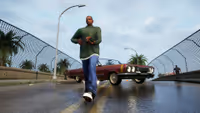
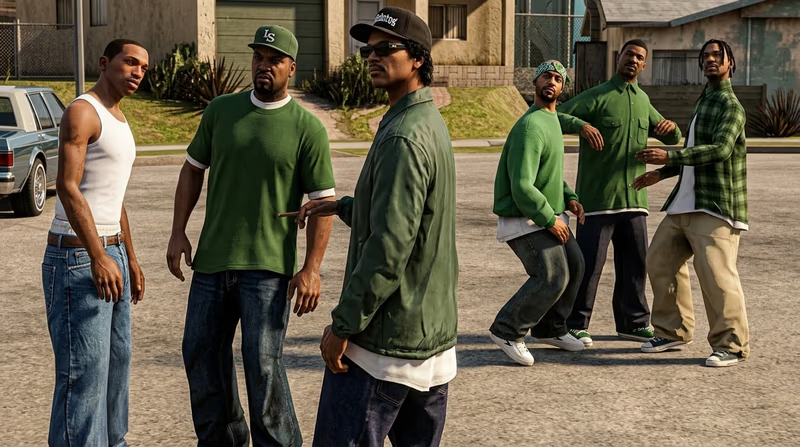
Grand Theft Auto: San Andreas — Rockstar North, 2004

CJ steps off the plane at Los Santos International already in trouble, and the opening hours make sure you feel it. "Big Smoke" and "Ryder" ease you into drive-bys and territory basics, but the run that actually teaches the game's rhythm is "Cesar Vialpando": tail Cesar's lowrider, listen to what he says about Kendl, and don't crash into a parked car trying to stay close. From there, Sweet hands out a string of Grove Street jobs that exist to rebuild the gang's reputation one block at a time.
Treat this stretch as the tutorial it is. The game won't say so directly, but every mechanic it introduces here (aiming on foot, drive-by shooting, basic stat tracking) reappears at higher difficulty later.
The story sharpens once Officer Tenpenny forces CJ into his pocket. "Burning Desire" is a straightforward firebombing job, but "Gray Imports" introduces the stealth-adjacent pacing Rockstar would lean on more in later games, move too aggressively and the warehouse guards swarm. The arc builds to "The Green Sabre," the mission where Big Smoke's betrayal becomes explicit and Grove Street effectively collapses around CJ in real time.
This section ends with CJ exiled from Los Santos under a bounty, which is the game's actual structural hinge, everything that follows in the countryside and San Fierro only exists because this arc burns Grove Street down first.
"Wrong Side of the Tracks" is the mission most players remember for the wrong reasons: CJ and the Truth's associate Catalina rob a moving train while riding motorcycles alongside it. The trick isn't raw driving skill, it's positioning. Stay level with the open boxcar doors rather than trying to out-accelerate the train, and let Catalina's gunfire do the clearing while CJ focuses on not clipping the track's support beams.
The countryside stretch is also where San Andreas quietly teaches off-road driving and rural navigation, skills the Las Venturas desert missions assume you already have.
San Fierro's contact missions split between The Truth's drug-tinged comic relief and Woozie's triad-adjacent crew, and the city itself gates progress behind a driving school requirement for the first time. "Wu Zi Mu" introduces Woozie properly, while the "Mountain Cloud Boys" arc builds toward the garage heist sequence that defines this city's act.
San Fierro's pacing is slower than Los Santos by design, Rockstar uses it to stretch out side content (the BMX and NRG-500 unlocks, the low-rider and street-race side jobs) before Las Venturas accelerates again.
Las Venturas opens with Woozie's turf war against the Triads, but the city's main event is the Four Dragons Casino heist arc, a direct homage to the Vegas-heist genre that culminates in CJ, Woozie, and the crew pulling off a full casino robbery across multiple interconnected missions. Before the heist can start, the game demands you've built out a getaway crew and completed setup jobs that each unlock one specialist (a hacker, a demolitions expert, a getaway driver).
Once the heist missions resolve, the plot pivots hard back toward Los Santos, and Las Venturas effectively becomes a sandbox of side content for the remainder of the playthrough.
The endgame drags CJ back to Los Santos for a direct confrontation with Tenpenny and the remnants of the Ballas-Vagos conflict. "Freefall" is a mandatory skydiving sequence, CJ must land precisely on a moving big rig, and overcorrecting the parachute steering is the single biggest cause of failed attempts, small adjustments land the chute far more reliably than sharp turns. The story then barrels into "Riot," a mission set during the Los Santos riots that externally mirrors the 1992 unrest, and finally "End of the Line," the confrontation that closes CJ's arc with Tenpenny.
Completing "End of the Line" closes the main story, though San Andreas keeps dozens of side missions, gang territories, and collectibles open for players who want to keep building CJ's stats after the credits roll.
A handful of missions trip up most players regardless of overall skill, and they tend to share one trait: the game expects a specific technique rather than raw reflexes.
None of these missions require a different build or extra grinding, they require matching the specific input pattern San Andreas built the mission around. Once that clicks, the "notorious" reputation these missions carry stops making sense.

Affiliate link: Support the blog via Instant Gaming at no extra cost.
Grand Theft Auto: San Andreas
Others Posts
Grand Theft Auto: San Andreas sent CJ across three fictional cities and an entire state, building the biggest, most ambitious open world of the PS2 era.
Grand Theft Auto IV: The Complete Edition bundles Niko Bellic's original story with both Episodes from Liberty City DLCs, and still holds up as one of the most atmospheric open worlds Rockstar ever built.

A practical beginner's guide to Grand Theft Auto IV: The Complete Edition, covering early money-making, which weapons and vehicles to prioritize, and how to approach the bundled Episodes from Liberty City content.
Rockstar San Diego's Red Dead Redemption traded Liberty City's skyline for the dying American frontier, delivering one of the finest open-world westerns ever made.
A complete checklist for reaching 100% completion in Grand Theft Auto: San Andreas, covering every collectible, vehicle mission, driving school, and asset you need to lock down.
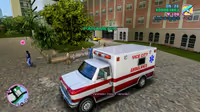
A complete breakdown of San Andreas's gang war system — how to trigger territory takeovers, beat the Ballas and Vagos in a turf war, and turn Grove Street into a money-printing empire.
Valve took the tightest puzzle design in the industry, doubled the toolset, added a co-op campaign and two of gaming's best-written characters, and somehow made the sequel better than the original.

Anno 1800 rebuilds the series around the smoke and steel of the second Industrial Revolution, turning supply-chain logistics into the genre's richest city-building puzzle.
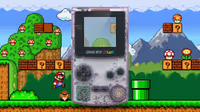
An engineering retrospective on the Nintendo Game Boy Color. We explore how a double-speed Sharp SM83 core, a backward-compatible palette-mapped color LCD, and translucent 'Atomic Purple' shells turned a stopgap handheld into the system that carried Pokémon's second generation.

Analysis of the PlayStation 4 and PS4 Pro hardware. We examine the shared CPU bottleneck, the mirrored butterfly GPU design, memory optimizations, and the hardware-level checkerboard rendering that enabled the 4K transition.
games
Techland traded gritty realism for painterly legend in this arcade-shooter retelling of the Old West's most famous gunslingers, bounty hunters, and outlaws.
