How the Nintendo Wii Conquered the Gaming World
We explore how Nintendo traded teraflops for accessibility, turning a glorified remote control into a global cultural phenomenon that brought gaming to living rooms, retirement homes, and the masses.
Nano Banana

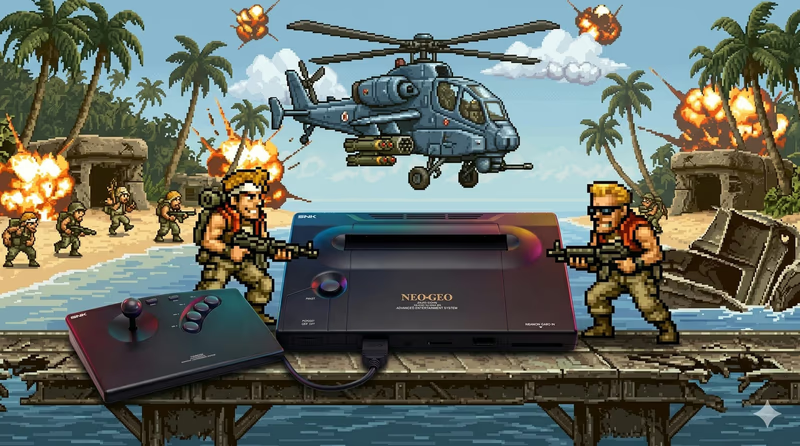
We explore how SNK defied market logic by packaging exact arcade hardware for the living room, creating a brutally powerful, absurdly expensive 16-bit console that became the ultimate status symbol and reigned supreme for an astonishing 14 years.
To understand the Neo Geo AES (Advanced Entertainment System), we must travel back to the early 1990s. During this era, the arcade was the undisputed pinnacle of video game technology. Home consoles like the Sega Mega Drive and Super Nintendo offered admirable ports, but they were ultimately compromised facsimiles of the true arcade experience.
SNK, a dominant force in the amusement industry, revolutionized arcades with the MVS (Multi Video System). Instead of forcing arcade operators to buy an entirely new, expensive wooden cabinet for every new game, the MVS utilized a single, powerful motherboard that accepted interchangeable ROM cartridges. It was a massive cost-saving ingenuity for operators.
Then, SNK made an audacious decision: what if they took that exact, uncompromising professional MVS arcade board, wrapped it in a sleek black plastic shell, and sold it to consumers? Initially, SNK believed the system was too expensive for retail, offering it exclusively as a rental unit in Japanese hotels and video stores in 1990. However, the sheer demand from hardcore gamers pushed SNK to release it publicly. The Neo Geo AES was born, bringing the actual arcade to the living room with zero technical compromises.
As hardware analysts, looking at the Neo Geo AES spec sheet is a masterclass in 16-bit brute force. It shared a similar CPU architecture with the Sega Mega Drive, but operating on a completely different tier of performance.
Everything about the AES was designed to exude premium luxury, right down to the peripherals and physical media.
The uncompromising nature of the hardware resulted in a financial barrier to entry that made the console mythical among schoolyard circles.
When the Neo Geo AES launched in the United States, it retailed for $649 (equivalent to roughly $1,500 today). But the console was only half the financial battle. Because the cartridges housed massive amounts of raw silicon memory straight from the arcades, a single game cost between $200 and $300.
SNK was not competing with Nintendo or Sega for market share. They were operating in a completely different stratosphere. The AES was targeted at wealthy adults and absolute purists who demanded perfection and were willing to pay the ultimate premium to get it.
When Capcom released Street Fighter II in 1991, the arcade landscape shifted permanently toward competitive fighting games, and SNK pivoted their entire hardware ecosystem to dominate this genre.
The most astonishing technical feat of the Neo Geo AES is not its speed, but its unnatural lifespan. The console survived the 16-bit era, lived through the 32-bit/64-bit 3D revolution of the PlayStation and N64, and continued to receive officially licensed software releases until 2004 with Samurai Shodown V Special. A 14-year official lifespan is practically unheard of in consumer electronics.
Today, the Neo Geo AES has transitioned from a high-end luxury item to the absolute Holy Grail of retro game collecting. Pristine AES hardware commands premium prices, and certain rare cartridges—such as the legendary European English release of Kizuna Encounter—are known to sell for tens of thousands of dollars at auction.
The Neo Geo AES remains the most uncompromising console ever manufactured. It was a beautiful, absurdly expensive love letter to the arcade, forever cementing its status as the ultimate myth of gaming hardware history.

Affiliate link: Support the blog via Instant Gaming at no extra cost.
Atari 7800
Others Posts
We explore how Nintendo traded teraflops for accessibility, turning a glorified remote control into a global cultural phenomenon that brought gaming to living rooms, retirement homes, and the masses.
We explore the towering ambition, the infamously complex dual-CPU architecture, and the legendary, arcade-perfect library.

We explore how Nintendo dominated the 16-bit console war not through sheer CPU speed, but through a masterful integration of custom audio-visual processors, revolutionary controller ergonomics, and an ingenious strategy of in-cartridge hardware expansion.
We explore how a broken handshake between Nintendo and Sony birthed a 32-bit titan. By combining developer-friendly hardware, the vast storage of the CD-ROM, and an aggressive marketing strategy

We explore how the Switch OLED prioritizes sensory refinement over brute force, pairing a stunning, high-contrast display and superior engineering with one of the greatest software libraries in gaming history.
An analytical case study of the Nintendo Entertainment System. We explore how Nintendo merged highly efficient 8-bit silicon with aggressive hardware-based DRM (the 10NES chip) and ingenious industrial design

RoboCop: Rogue City: Teyon's faithful adaptation, Peter Weller's return, the sheer power of the Auto-9, and the gritty streets of Old Detroit.

Mutant Year Zero: Road to Eden: XCOM-style tactical combat, real-time stealth infiltration with Dux and Bormin, and the secrets of The Zone.
Conquer the toughest bosses in Minecraft Dungeons. Master attack patterns, exploit weak points, and equip the best builds for every major fight.

Are the Minecraft Dungeons DLCs worth buying? We break down all 6 expansions, their biomes, unique mechanics, boss fights, and rank the absolute must-haves.
games
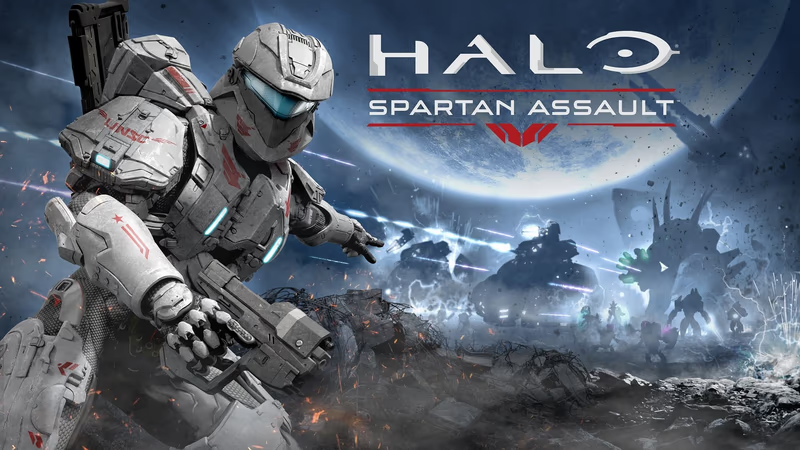
Halo: Spartan Assault: 343 Industries' jump into the twin-stick shooter genre, the battles of Sarah Palmer, and the heavy baggage of its mobile origins.
