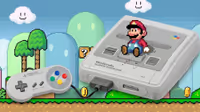
An analytical case study of the Nintendo Entertainment System. We explore how Nintendo merged highly efficient 8-bit silicon with aggressive hardware-based DRM (the 10NES chip) and ingenious industrial design to single-handedly resurrect the North American video game industry following the catastrophic crash of 1983.
History
To understand the engineering behind the Nintendo Entertainment System (NES), one must first understand the hostile market it entered. Following the North American video game crash of 1983—caused by a flooded market of low-quality, unlicensed software—retailers outright refused to stock anything labeled a "video game console." The industry was considered a dead fad.
When Nintendo decided to bring their wildly successful 1983 Japanese "Famicom" to the West in 1985, they engineered a masterclass in psychological marketing. They completely redesigned the chassis, rebranded it as an "Entertainment System," and marketed it as a high-tech toy. By bundling it with R.O.B. (Robotic Operating Buddy) and a Zapper light gun, Nintendo successfully created a Trojan Horse. Retailers placed the NES in the toy aisles, bypassing the video game stigma entirely and quietly planting a powerful 8-bit computer in millions of living rooms.
Hardware Architecture
From a silicon perspective, the NES was a highly efficient machine that achieved its performance through a strict division of computational labor, separating game logic from graphical rendering.
- The CPU (Ricoh 2A03): The main processor was a custom Ricoh 2A03, based on the ubiquitous MOS Technology 6502 architecture. Clocked at just 1.79 MHz (in NTSC regions), it was cheap to manufacture but immensely versatile. This CPU handled the game's core logic, input polling, and collision detection.
- The Scrolling Miracle (The PPU): The true powerhouse of the system was the custom Picture Processing Unit (PPU). Designed specifically to handle sprites and background tiles, the PPU allowed for smooth, hardware-level lateral and vertical scrolling. While previous consoles struggled with static, single-screen arcade ports, the NES PPU allowed developers to program massive, contiguous, scrolling worlds—a technological leap that made Super Mario Bros. possible.
- The Sound of the 80s: The audio hardware was integrated directly into the CPU. The Audio Processing Unit (APU) featured five distinct channels: two pulse (square) waves, one triangle wave, one noise generator, and one DPCM (Delta Modulation) channel for low-quality voice samples. Composers like Koji Kondo used these severe mathematical limitations to their advantage, utilizing the triangle wave for driving basslines and the pulse waves for the unforgettable, piercing melodies that defined an era.
Industrial Design
Nintendo's desire to disguise the NES as a standard piece of home entertainment equipment led to one of the most famous hardware design flaws in consumer electronics.
- The Front-Loading Mechanism: To mimic the look of a premium VCR, Nintendo utilized a front-loading mechanism with a Zero Insertion Force (ZIF) connector. Users pushed the cartridge in and pressed it down to lock it into place, a stark contrast to the traditional top-loading design of older consoles.
- The Design Flaw: The 72-pin ZIF connector was a mechanical liability. The constant up-and-down friction bent the nickel-plated pins over time, making them highly susceptible to oxidation and dust buildup. This poor connection triggered the console's internal reset loop, resulting in the infamous "Blinking Red Light." This flaw birthed the ubiquitous myth that blowing into the cartridge fixed the issue; in reality, the moisture from human breath only accelerated the corrosion of the copper contacts.
- The Ergonomic Revolution: While the console's loading mechanism was flawed, its controller was a masterpiece. Designed by Gunpei Yokoi, the NES controller abandoned the bulky, rigid arcade joysticks of the Atari era in favor of a flat, thumb-operated "D-pad" (Directional Pad). This single hardware innovation standardized video game ergonomics for the next four decades.
Business Engineering: The 10NES Chip and the Seal of Quality
The NES is the ultimate example of hardware engineering being weaponized to enforce a business model.
- The Lockout Chip (10NES): Nintendo developed a patented authentication chip known as the 10NES. One half of this chip was placed on the console's motherboard, and the matching half was placed inside every official game cartridge. Upon booting, the two chips essentially performed a digital handshake. If the console did not detect the proper 10NES chip in the cartridge, it would lock the system in an infinite reset loop.
- The Licensing Monopoly: This hardware DRM allowed Nintendo to exert iron-fisted control over the market. Because third-party developers could not physically manufacture compatible cartridges without Nintendo's proprietary chip, they were forced into strict licensing agreements. Nintendo dictated that developers could only release five games a year and required all games to pass their "Seal of Quality" standards. This hardware-enforced monopoly actively prevented the shovelware that caused the 1983 crash, ensuring the ecosystem remained profitable and stable.
In-Cartridge Expansion: Batteries and Mappers
As the 8-bit era progressed, the NES hardware naturally began to age. However, Nintendo ingeniously engineered the console to be upgraded via the software cartridges themselves.
- Memory Management Controllers (MMCs): To bypass the console's strict RAM and ROM limitations, developers included custom MMC chips directly onto the cartridge PCBs. These "mappers" allowed the system to bank-switch memory on the fly, unlocking the ability to render far more complex graphics, diagonal scrolling, and massive game sizes (as seen in the massive leap from the original Super Mario Bros. to Super Mario Bros. 3).
- Persistent Memory: In 1987, The Legend of Zelda introduced a revolutionary hardware feature: an onboard SRAM chip powered by a small CR2032 watch battery inside the cartridge. This allowed the game to physically save the player's progress. By eliminating archaic password systems, the NES could now support massive, non-linear adventures that took dozens of hours to complete.
Legacy and Industry Standardization
The Nintendo Entertainment System achieved total market dominance, selling nearly 62 million units worldwide.
However, its true legacy is not just its sales figures, but its architectural and economic blueprint. The NES codified the modern video game industry. By proving that a company could sell capable, affordable hardware at scale, standardize the control interface, and use silicon-level authentication to strictly control a lucrative third-party software licensing ecosystem, Nintendo wrote the exact business playbook that Sony, Microsoft, and Nintendo themselves continue to operate by today.