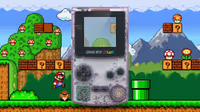
An engineering retrospective on the original Nintendo Game Boy. We explore how Sharp's custom LR35902 CPU, a monochrome reflective LCD, and Gunpei Yokoi's "lateral thinking with withered technology" philosophy turned modest specs into a handheld dynasty that outlived every rival that tried to out-spec it.
History: Withered Technology and a Dying Market
By 1989, the handheld market already had a corpse count. Milton Bradley's Microvision had flopped in 1979, and a wave of dedicated LCD games from Tiger Electronics and Nintendo's own Game & Watch line had proven that people wanted portable play but hadn't proven anyone could sustain it as a platform. Into that uncertain space, Nintendo dropped the Game Boy, designed under Gunpei Yokoi, the engineer who had already built the Game & Watch and the Ultra Hand.
Yokoi's guiding principle was "kareta gijutsu no suihei shikō," usually translated as "lateral thinking with withered technology." Rather than chase the newest, most power-hungry components, Yokoi deliberately chose mature, cheap, well-understood parts and found novel uses for them. Sega's rival Game Gear, launched a year later, embarrassed the Game Boy on paper: a backlit color screen, a faster processor, genuine arcade-adjacent horsepower. It also drained four AA batteries in under five hours and cost more. The Game Boy ran for roughly 30 hours on the same four AAs. Longevity, not spec sheets, won the generation.
The CPU and System-on-Chip Design
At the Game Boy's core sits the Sharp LR35902, a custom chip that blends instructions from the Zilog Z80 with elements of the Intel 8080, clocked at 4.19 MHz. It isn't a licensed Z80 and it isn't an 8080 clone — it's a hybrid instruction set that Nintendo and Sharp built specifically for this machine, which is why Game Boy assembly code reads close to Z80 assembly but trips up anyone who assumes full compatibility.
- Single-chip integration: The LR35902 wasn't just a CPU. Sharp folded the processor, the picture processing circuitry, and sound generation hardware onto a single custom silicon package, a system-on-chip approach that kept manufacturing costs down and let Nintendo hit an $89.99 launch price in the US.
- 8-bit simplicity by design: Where competitors reached for 16-bit chips to chase Game Gear and Atari Lynx bragging rights, Nintendo stayed 8-bit on purpose. Fewer transistors meant less heat, less current draw, and a chip Sharp could fabricate in volume without yield problems.
- Memory footprint: 8KB of work RAM and 8KB of video RAM, a number that looks almost comic next to a modern phone, but Nintendo's own first-party titles proved it was enough: Tetris, Super Mario Land, and The Legend of Zelda: Link's Awakening all shipped inside that budget.
The Screen: Engineering Around a Reflective LCD
The single biggest trade-off in the entire machine is the screen, and it's the trade-off Yokoi made most deliberately. The 160x144 pixel display uses a reflective (non-backlit) twisted nematic LCD capable of four shades: black, dark grey, light grey, and the washed-out pale green that became the console's visual signature.
A backlight would have devoured the Game Boy's battery life in hours rather than days. Sega learned that the hard way with the Game Gear's backlit screen; Atari learned it even harder with the Lynx. Nintendo's reflective panel instead bounced ambient light back through the liquid crystal layer, which meant the console was completely unusable in the dark and genuinely difficult to read in dim indoor lighting without a desk lamp angled just right. Players compensated with clip-on lights sold as third-party accessories, an entire cottage industry built around a screen Nintendo refused to backlight.
- Ghosting and motion blur: The LCD's slow pixel response time smeared fast-moving sprites into trailing shadows, a quirk emulators now have to deliberately simulate to recreate the "authentic" look.
- No color, by necessity: A color-capable LCD of the era demanded substantially more power and cost. Monochrome wasn't a compromise forced by ignorance, it was the direct consequence of prioritizing battery life and a sub-$100 price point above all else.
Audio Architecture
The Game Boy's sound hardware shares DNA with the NES's APU but adds a fourth voice tailored for handheld use. Two programmable pulse-wave channels handle melody and harmony, a single wavetable channel allows custom 4-bit waveforms (the source of the system's uniquely reedy bass tones), and a noise channel generates percussion and explosion effects via a pseudo-random LFSR circuit.
Composers like Hirokazu Tanaka, who scored the original Super Mario Land, learned to treat those four channels as a tight ensemble rather than a limitation. The wavetable channel in particular became a signature: it let Game Boy soundtracks carry a thin, slightly detuned low end that no other 8-bit handheld's hardware reproduced, and chiptune artists still chase that exact timbre decades later on real DMG units and FPGA clones alike.
Industrial Design and Battery Life
Yokoi's team wrapped the electronics in a chunky, battleship-grey brick that weighed roughly 220 grams without batteries and noticeably more with its four AAs installed. The proportions were never meant to be elegant. They were meant to survive being dropped, sat on, and shoved into a backpack by kids who had no intention of babying their hardware.
- The D-pad legacy: The same cross-shaped directional pad Yokoi designed for the NES controller carried over directly, now sized for thumbs gripping a handheld rather than resting on a table.
- Four-AA runtime: Roughly 30 hours of play per set of batteries, a figure Nintendo could only hit because the unbacklit screen and the modest 4.19 MHz clock sipped power instead of gulping it.
- The link cable port: A proprietary serial port on the top edge enabled two-player link cable connections, the hardware foundation that made Tetris multiplayer and the entire Pokémon trading mechanic possible years later.
Business Engineering: Cartridges, Link Cable, and Tetris
Hardware alone didn't win the handheld war. Nintendo's decision to bundle Tetris with the console in Western markets, rather than Super Mario Land, is one of the shrewder packaging calls in console history. Alexey Pajitnov's puzzle game appealed to an audience far wider than core gamers, and its two-player link cable mode gave owners an immediate reason to convince a friend to buy one too.
- Cartridge economics: Like the NES before it, Game Boy software shipped on ROM cartridges, giving Nintendo the same licensing leverage and per-unit royalty structure that had defined its home console business.
- The link cable network effect: Every Game Boy sold created demand for a second Game Boy. Tetris, and later Pokémon Red and Blue's trading and battling, turned the link cable from a novelty port into the console's most important feature.
- Third-party support: The low manufacturing cost of Game Boy cartridges, driven directly by the console's modest memory and processing requirements, made it cheap enough for small studios to publish on, flooding the library with budget titles that a pricier, flashier handheld simply couldn't support at the same volume.
Hardware Revisions: Pocket, Light, and Color
Nintendo kept the original DMG's core architecture alive for over a decade by iterating on the chassis rather than replacing the platform outright.
- Game Boy Pocket (1996): A dramatically smaller, lighter redesign that dropped the AA count from four to two and swapped the murky green-tinted screen for a sharper, higher-contrast grey-on-white LCD. The CPU and memory map stayed identical, preserving full software compatibility.
- Game Boy Light (1998, Japan only): Essentially a Pocket chassis with an electroluminescent backlight panel added, finally addressing the console's original visibility complaint. Nintendo never released it outside Japan, leaving the rest of the world to keep buying clip-on lights.
- Game Boy Color (1998): The real architectural leap. Nintendo doubled the CPU clock to roughly 8.4 MHz, expanded work RAM to 32KB, and replaced the reflective monochrome panel with a color-capable screen supporting up to 56 simultaneous colors from a palette of 32,768. Crucially, it remained backward compatible with the entire original cartridge library, so the installed base of DMG software never became obsolete.
Each revision shrank the footprint or improved the screen without breaking the thing that mattered most: every Game Boy cartridge made since 1989 still worked in whatever model you bought next.
The Library: Essential Games That Proved the Hardware Right
None of the architecture above matters without software that exploited it, and the Game Boy's library produced more than its share of genre-defining titles within four shades of grey.
- Tetris (1989): The pack-in that sold the hardware. Pajitnov's puzzle design fit the 160x144 screen perfectly and turned the link cable port into a must-have feature rather than an afterthought.
- Super Mario Land (1989): Yokoi's own team compressed the Mario formula into a tighter, stranger package, complete with a submarine shooting stage and a final boss fight against an alien in a UFO.
- The Legend of Zelda: Link's Awakening (1993): A full open-world Zelda crammed into 8KB of work RAM, proof that the console's memory ceiling was a constraint developers could out-design rather than a wall they hit.
- Pokémon Red and Blue (1996, Japan 1998 West): The title that single-handedly extended the DMG's commercial life by half a decade, built entirely around the link cable's trading and battling functions.
- Metroid II: Return of Samus (1991): A grim, claustrophobic sequel that reworked Samus's moveset and introduced lore mechanics later games would lean on for years.
- Kirby's Dream Land (1992): HAL Laboratory's debut for the character, deliberately tuned as an approachable, shorter adventure that still showed off smooth scrolling the hardware wasn't originally expected to deliver.
Legacy
Nintendo's own cumulative figure for the Game Boy line, spanning the original DMG through the Pocket, Light, and Color models, sits at 118.69 million units sold worldwide. No clean public breakdown isolates the original grey brick's standalone sales from its successors, but it was the model that established the install base every later revision built on.
The real legacy isn't the unit count, it's the proof of concept. Yokoi showed that a handheld built from cheap, mature parts and aimed squarely at battery life could out-sell and outlast rivals with objectively superior specs. Every Nintendo handheld since, from the Game Boy Advance through the Nintendo DS to the Switch's portable mode, inherited that same bet: durability and runtime beat raw horsepower when the hardware has to survive a kid's backpack.