PlayStation 5 (PS5) Hardware Analysis
The PlayStation 5 hardware architecture. We analyze Mark Cerny's custom I/O complex, the revolutionary 825GB SSD, liquid metal thermal engineering, and how Sony eradicated the traditional storage bottleneck.

Nano Banana

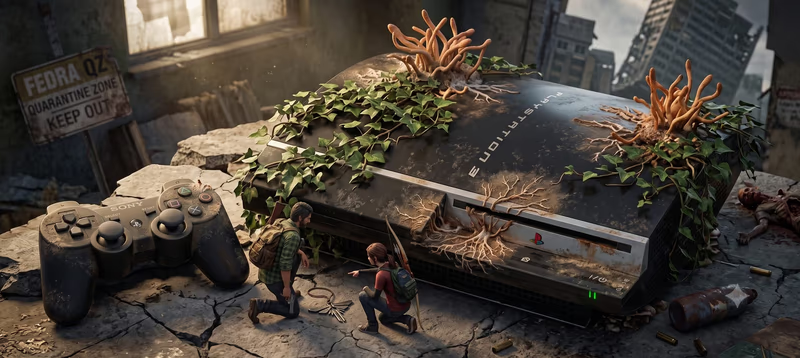
A technical breakdown of the PlayStation 3's engineering and market performance. We examine the notoriously complex Cell Broadband Engine, the split-memory bottleneck, and how Sony's initial hardware hubris forced an incredible software redemption that fundamentally altered the company's approach to console design.
Following the unprecedented global success of the PlayStation 2, Sony Computer Entertainment entered the next generation with a distinct sense of invincibility. Under the direction of hardware engineer Ken Kutaragi, Sony decided the PlayStation 3 would not just be a gaming console, but a centralized supercomputer intended to control the entire living room.
This corporate arrogance culminated at E3 2006. Sony announced the launch price for the premium 60GB model: $599. Combined with a presentation that felt entirely out of touch with consumer realities, this astronomical price tag instantly alienated the player base. By assuming the market would pay whatever was asked simply because it carried the PlayStation logo, Sony handed an immediate, massive market share lead to Microsoft's cheaper, developer-friendly Xbox 360.
The engineering core of the PS3 is the most exotic silicon ever placed in a consumer console. Co-developed by Sony, Toshiba, and IBM, the Cell processor was a mathematical powerhouse on paper, but a logistical nightmare in practice.
Sony intentionally engineered the PS3 to act as a Trojan Horse in the high-definition optical disc format war. By including a Blu-ray drive as standard, Sony took staggering financial losses on every console sold just to force the format's adoption over Toshiba's rival HD DVD.
While this drastically inflated the console's retail price, it provided a massive long-term advantage for game development. Standard DVDs on the Xbox 360 maxed out at roughly 8.5GB, forcing major titles to ship on multiple discs and heavily compress their audio. The PS3's 50GB dual-layer Blu-ray discs allowed developers to include uncompressed 7.1 surround sound audio, massive texture pools, and pre-rendered cinematics without forcing the player to swap discs mid-game.
The physical manufacturing of the early PS3 models was entirely unsustainable.
The PS3 was ultimately saved by the sheer programming talent of Sony's internal studios. Late in the console's lifecycle, teams like Naughty Dog, Santa Monica, and Guerrilla Games finally cracked the Cell architecture.
They discovered the ultimate technical workaround for the console's limitations. The PS3's GPU (the Nvidia RSX) was relatively weak and prone to bottlenecking. To fix this, first-party programmers stopped using the Cell's SPEs for game logic and instead repurposed them to calculate graphics. By offloading complex lighting, physics, and post-processing anti-aliasing (MLAA) directly onto the CPU, they bypassed the GPU limitations entirely. This technique produced technical marvels like Uncharted 2 and The Last of Us, pushing visual fidelity far beyond what the Xbox 360 could render.
Through aggressive price cuts and a relentless output of high-quality exclusive software, the PlayStation 3 managed a miraculous recovery. By the end of the generation, it effectively tied the Xbox 360 in global hardware sales, clearing 87 million units.
However, the true legacy of the PS3 is the harsh lesson it taught Sony's executive board. The extreme difficulty of programming for the Cell processor alienated developers and almost destroyed the PlayStation brand. Sony internalized this failure entirely. When it came time to design the PlayStation 4, lead architect Mark Cerny abandoned exotic, proprietary silicon entirely, opting instead for standard x86 PC architecture to ensure that the console was as developer-friendly as possible.

Affiliate link: Support the blog via Instant Gaming at no extra cost.
PlayStation 3
Others Posts
The PlayStation 5 hardware architecture. We analyze Mark Cerny's custom I/O complex, the revolutionary 825GB SSD, liquid metal thermal engineering, and how Sony eradicated the traditional storage bottleneck.
PlayStation 5 Pro hardware: PSSR, Advanced Ray Tracing, and the AI Revolution. We analyze Sony's PlayStation Spectral Super Resolution (PSSR), RDNA 4 Ray Tracing advancements, and the engineering behind the end of the Fidelity vs. Performance compromise.

Analysis of the PlayStation 4 and PS4 Pro hardware. We examine the shared CPU bottleneck, the mirrored butterfly GPU design, memory optimizations, and the hardware-level checkerboard rendering that enabled the 4K transition.

We analyze Mark Cerny's butterfly GPU architecture, the implementation of hardware-level checkerboard rendering, and the engineering tricks used to deliver a 4K experience without fragmenting the generation.

A technical and historical breakdown of the Nintendo Wii U. We examine how its architectural bottlenecks, confusing marketing, and miraculous low-latency GamePad created a commercial failure that ultimately served as the essential prototype for Nintendo's modern hardware dominance.

We analyse how Sony abandoned exotic proprietary silicon for standardized x86 architecture, the critical 8GB GDDR5 memory upgrade, and how Mark Cerny's developer-focused design philosophy dominated the eighth console generation.


RoboCop: Rogue City: Teyon's faithful adaptation, Peter Weller's return, the sheer power of the Auto-9, and the gritty streets of Old Detroit.

Mutant Year Zero: Road to Eden: XCOM-style tactical combat, real-time stealth infiltration with Dux and Bormin, and the secrets of The Zone.

Conquer the toughest bosses in Minecraft Dungeons. Master attack patterns, exploit weak points, and equip the best builds for every major fight.

Are the Minecraft Dungeons DLCs worth buying? We break down all 6 expansions, their biomes, unique mechanics, boss fights, and rank the absolute must-haves.
games
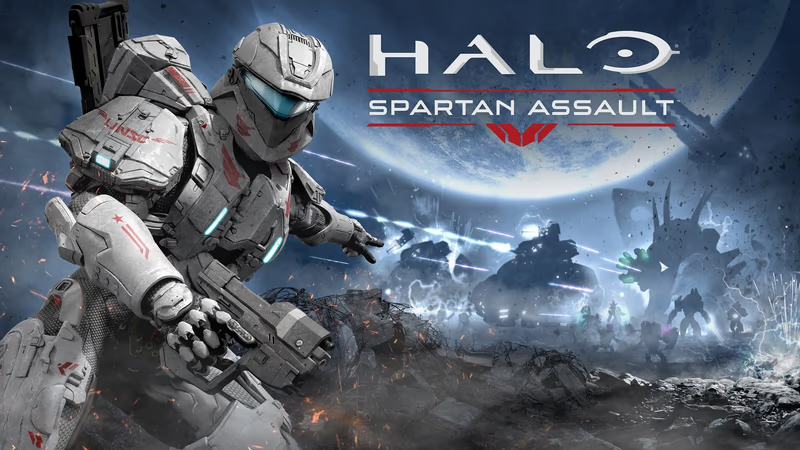
Halo: Spartan Assault: 343 Industries' jump into the twin-stick shooter genre, the battles of Sarah Palmer, and the heavy baggage of its mobile origins.
