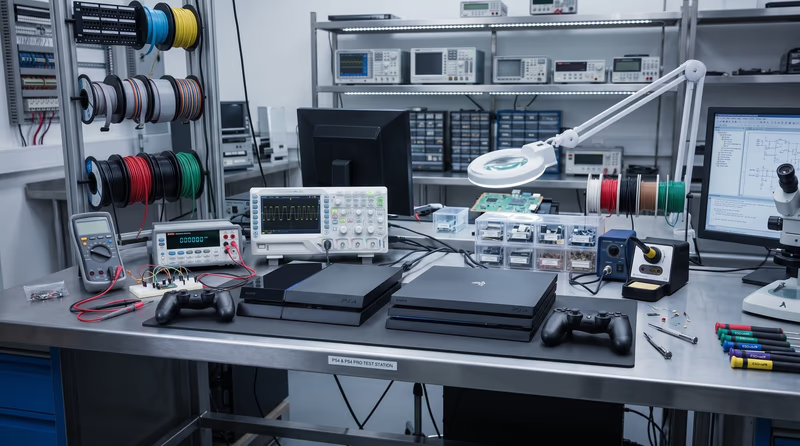
Analysis of the PlayStation 4 and PS4 Pro hardware. We examine the shared CPU bottleneck, the mirrored butterfly GPU design, memory optimizations, and the hardware-level checkerboard rendering that enabled the 4K transition.
Historical Context: Breaking the 7-Year Cycle
The PlayStation 4 launched in 2013 with a very specific engineering target: dominate the 1080p (Full HD) display standard using efficient, developer-friendly x86 architecture. However, the consumer electronics market moved faster than anticipated. By 2016, the massive and rapid adoption of 4K (UHD) televisions threatened to render the base PS4 visually obsolete halfway through its intended seven-year lifecycle.
This market shift forced Sony to release the PlayStation 4 Pro, creating the industry's first true "mid-cycle upgrade." The engineering challenge was immense: the PS4 Pro needed to output convincing 4K graphics, but Sony enforced a strict "no fragmentation" mandate. There could be no PS4 Pro exclusive games. The base PS4 and the PS4 Pro had to operate within the exact same software ecosystem, meaning the Pro’s architecture had to be structurally identical to the 2013 model while simultaneously delivering more than double the graphical power.
The CPU: The Shared Bottleneck
When comparing the two systems, the central processing unit highlights the strict compromises required to maintain perfect backward compatibility.
- The AMD "Jaguar" Architecture: Both consoles utilize the exact same 8-core AMD Jaguar CPU architecture. Upgrading the Pro to a newer, more efficient processor design would have inherently altered how code was executed, risking fatal crashes in older, unpatched games.
- The Clock Speed Bump: To extract more performance, Sony simply overclocked the existing silicon. The base PS4 CPU runs at 1.6 GHz, while the PS4 Pro CPU runs at 2.1 GHz—a modest increase of roughly 31%.
- The 60fps Penalty: This shared architecture explains the most common frustration with the PS4 Pro. In video game rendering, physics calculations, geometry, and artificial intelligence are bound strictly to the CPU. Because the CPU in the Pro was only marginally faster than the base model, it remained a severe bottleneck. The Pro rarely possessed the computational logic required to double a game's framerate from 30fps to 60fps, forcing developers to use the machine's extra power almost exclusively to push higher resolutions rather than smoother gameplay.
The GPU: Direct Rendering vs. "Butterfly" Design
The Graphics Processing Unit is where the two consoles fundamentally diverge. The base PS4 outputs 1.84 Teraflops of graphical compute power, while the PS4 Pro leaps to 4.2 Teraflops. However, the way this upgrade was physically implemented is a masterclass in redundancy engineering.
Instead of designing a completely new GPU, lead architect Mark Cerny utilized a mirrored "butterfly" design for the PS4 Pro. Sony essentially printed a second, identical base PS4 GPU right next to the original one on the same silicon die.
This design elegantly solved the compatibility mandate at the hardware level:
- Base PS4 Mode: When a user boots up an older, unpatched game from 2013, the PS4 Pro physically cuts the power to half of its GPU. By effectively shutting down the "new" half, the console perfectly mimics the 1.84 Teraflop environment of the base PS4, guaranteeing the game runs exactly as originally programmed without timing errors.
- Pro Mode: When a Pro-patched game is detected, both halves of the GPU ignite, unlocking the full 4.2 Teraflops and advanced features like FP16 half-precision computing to accelerate visual effects.
Memory: Brute Force vs. Asymmetric Optimization
Both the base PS4 and the PS4 Pro feature 8 GB of unified GDDR5 RAM. To handle the larger textures required for 4K displays, Sony increased the memory bandwidth on the Pro from 176 GB/s to 218 GB/s. Yet, higher bandwidth alone doesn't solve the capacity problem—4K assets take up more physical space in the memory pool.
To give developers more room without abandoning the 8 GB standard, Sony implemented a brilliant asymmetric hardware trick on the Pro:
- The Hidden DDR3 Chip: In the base PS4, the operating system aggressively reserves a chunk of the GDDR5 memory to keep background applications (like Netflix or the dashboard) suspended and ready. On the PS4 Pro, Sony soldered an additional, highly inexpensive 1 GB DDR3 memory chip directly onto the motherboard.
- The Result: The Pro offloads the suspended background operating system entirely into this slow DDR3 chip. This simple hardware addition freed up nearly a full gigabyte of the ultra-fast GDDR5 RAM, handing it directly back to the game developers to stream massive 4K textures.
Rendering Strategies: Native 1080p vs. Checkerboard Rendering
The base PS4 was engineered to excel at traditional rasterization. It possessed exactly enough brute force to natively render a 1080p image (roughly 2 million pixels per frame).
Native 4K, however, requires rendering 8.2 million pixels per frame. Even at 4.2 Teraflops, the PS4 Pro’s GPU was not powerful enough to render native 4K in modern, graphically intense AAA games. To bridge the mathematical gap, Sony integrated specialized hardware blocks into the Pro's GPU dedicated entirely to Checkerboard Rendering.
Instead of drawing every pixel, the PS4 Pro renders only 50% of the pixels in a checkerboard pattern (often at an internal resolution of 1440p or 1800p). The custom hardware then uses spatial algorithms and temporal data (movement captured from previous frames) to mathematically deduce and inject the missing pixels. The resulting image bypassed the hardware's limitations, delivering a display practically indistinguishable from native 4K at standard living room viewing distances while using only half the required computational power.
Conclusion
The technical comparison between these two machines highlights two distinct engineering philosophies. The base PS4 remains a triumph of standardized, efficient design that maximized a 1080p target. The PS4 Pro, conversely, is an exercise in extreme scaling, utilizing redundant silicon and mathematical extrapolation to cheat the limitations of its own shared CPU.
The lasting legacy of this hardware division was a fundamental cultural shift in console gaming. By forcing developers to optimize the exact same game for two distinctly different power profiles, the PS4 Pro introduced the PC-centric concept of the "Graphics Menu" to the console ecosystem. The player's ability to manually choose between a "Performance Mode" and a "Resolution Mode" was born directly from this mid-cycle hardware split—a standard that defines the console industry today.