The Swan Song of Silicon: A Technical Review of the Sega Dreamcast
An analytical autopsy of a machine that traveled from the future only to die too soon. We explore the brilliant, hyper-efficient engineering of the Sega Dreamcast.

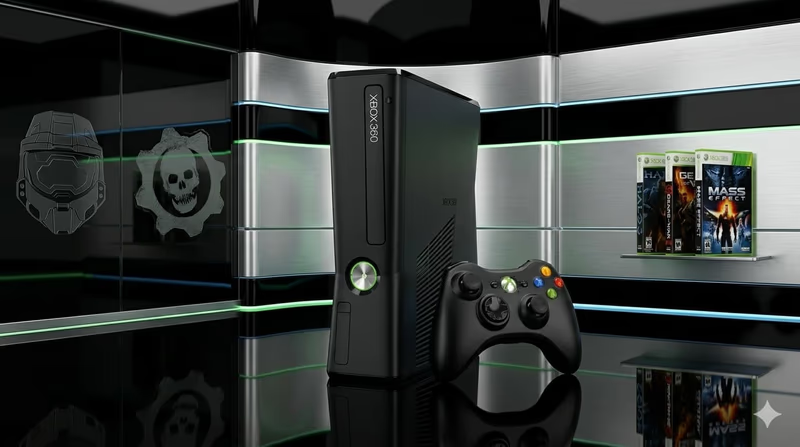
Nano Banana

An exhaustive technical and historical analysis of Microsoft’s defining console. We dissect the brilliant foresight of its unified shader architecture and digital ecosystem, while critically examining the catastrophic thermal engineering failure of the "Red Ring of Death." It is the story of a machine that pioneered the modern HD gaming landscape at an unprecedented financial cost.
To comprehend the Xbox 360, one must analyze Microsoft's strategic positioning in the mid-2000s. The original Xbox was a calculated $4 billion loss—a Trojan horse used to establish the Microsoft brand in the living room and build the foundational infrastructure for Xbox Live. For the seventh console generation, the corporate mandate in Redmond was clear: transition the industry to High Definition (HD), abandon the costly off-the-shelf PC parts of the original Xbox, and, most crucially, beat Sony’s PlayStation 3 to market.
To achieve hardware profitability and tighter system integration, Microsoft pivoted away from Intel and Nvidia. Instead, they forged alliances with IBM for the central processor and ATI (later acquired by AMD) for the graphics pipeline. The aggressive timeline dictated a November 2005 launch, securing a vital one-year head start against Sony. However, as hardware analysts can attest, accelerating the research, development, and mass manufacturing of bleeding-edge silicon inevitably courts disaster.
From an architectural standpoint, the Xbox 360 was a visionary piece of hardware that anticipated the future of both console and PC design.
This is the most critical juncture in the hardware’s history.
Aesthetically, the console was a triumph. Designed in collaboration with Astro Studios, the concave, matte-white chassis shed the bulky, VCR-like footprint of its predecessor. However, the internal physical engineering was fundamentally flawed, leading to the infamous General Hardware Failure, universally recognized by three flashing red quadrants: the Red Ring of Death (RROD).
The crisis was born from a perfect storm of design compromises and regulatory shifts. To achieve the console's sleek profile, the heat sinks for the CPU and GPU were perilously small, and the airflow was constrained. Compounding the issue was the European Union’s RoHS (Restriction of Hazardous Substances) directive, which mandated the use of lead-free solder in consumer electronics.
The console generated immense heat during gameplay and cooled down rapidly when turned off. This severe thermal cycling caused the motherboard to flex slightly. The rigid, lead-free Ball Grid Array (BGA) solder bumps connecting the GPU to the motherboard could not withstand this continuous microscopic flexing. They became brittle, fractured, and severed the connection between the GPU and the board.
Faced with a failure rate that independent analysts estimated at over 30% (some reporting as high as 50% for launch models), Microsoft executive Peter Moore made a historically unprecedented decision: extending the warranty to three years for the RROD and taking a staggering $1.15 billion financial write-down to repair and replace consoles. It was a massive hit to the bottom line, but it saved the Xbox brand from total collapse.
To halt the hemorrhage of failing consoles, Microsoft engineering embarked on an aggressive series of motherboard revisions, primarily focused on reducing the silicon lithography (die shrinks) to lower voltage and heat output.
The hardware’s ultimate success was driven by an uncompromising software lineup and the absolute dominance of Xbox Live.
The Xbox 360 concluded its lifecycle with approximately 84 million units sold globally. While it struggled continuously in the Japanese market, it absolutely dominated North America and the UK, spending years as the undisputed market leader before entering a statistical tie with the PlayStation 3 at the very end of the generation.
Its legacy is foundational to modern gaming. The Xbox 360 controller's asymmetrical analog stick layout and refined triggers established the ergonomic gold standard for the industry, remaining largely unchanged today. The console normalized digital storefronts, popularized the concept of persistent online identities, and permanently gamified the act of playing via the Gamerscore and Achievements system.
Despite its disastrous initial thermal engineering, the Xbox 360 stands as Microsoft's masterpiece—a machine that dictated the terms of the high-definition era and built the connected ecosystem that all contemporary consoles rely upon today.

Affiliate link: Support the blog via Instant Gaming at no extra cost.
Xbox 360
Others Posts
An analytical autopsy of a machine that traveled from the future only to die too soon. We explore the brilliant, hyper-efficient engineering of the Sega Dreamcast.
The PlayStation 5 hardware architecture. We analyze Mark Cerny's custom I/O complex, the revolutionary 825GB SSD, liquid metal thermal engineering, and how Sony eradicated the traditional storage bottleneck.

We explore how the Switch OLED prioritizes sensory refinement over brute force, pairing a stunning, high-contrast display and superior engineering with one of the greatest software libraries in gaming history.

A technical breakdown of the PlayStation 3's engineering and market performance. We examine the notoriously complex Cell Broadband Engine, the split-memory bottleneck.

We analyze Mark Cerny's butterfly GPU architecture, the implementation of hardware-level checkerboard rendering, and the engineering tricks used to deliver a 4K experience without fragmenting the generation.

Before Halo CE, console FPS games were a clunky joke. Discover how Bungie's golden triangle of combat and AI rewrote the rulebook forever.


RoboCop: Rogue City: Teyon's faithful adaptation, Peter Weller's return, the sheer power of the Auto-9, and the gritty streets of Old Detroit.

Mutant Year Zero: Road to Eden: XCOM-style tactical combat, real-time stealth infiltration with Dux and Bormin, and the secrets of The Zone.

Conquer the toughest bosses in Minecraft Dungeons. Master attack patterns, exploit weak points, and equip the best builds for every major fight.

Are the Minecraft Dungeons DLCs worth buying? We break down all 6 expansions, their biomes, unique mechanics, boss fights, and rank the absolute must-haves.
games
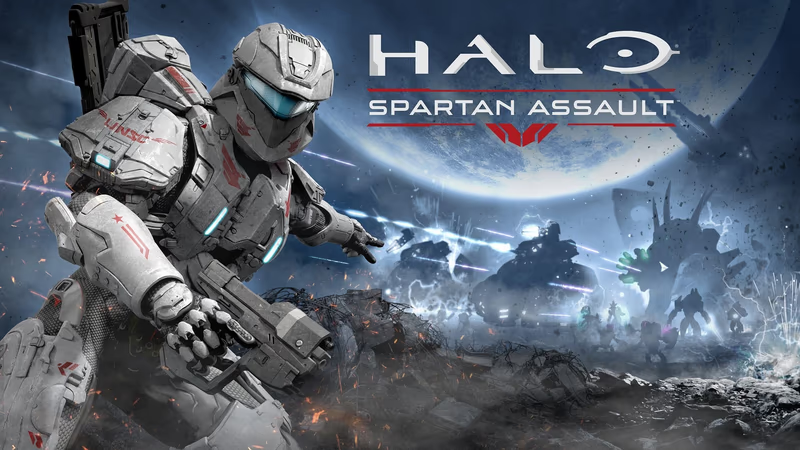
Halo: Spartan Assault: 343 Industries' jump into the twin-stick shooter genre, the battles of Sarah Palmer, and the heavy baggage of its mobile origins.
