PlayStation 5 (PS5) Hardware Analysis
The PlayStation 5 hardware architecture. We analyze Mark Cerny's custom I/O complex, the revolutionary 825GB SSD, liquid metal thermal engineering, and how Sony eradicated the traditional storage bottleneck.

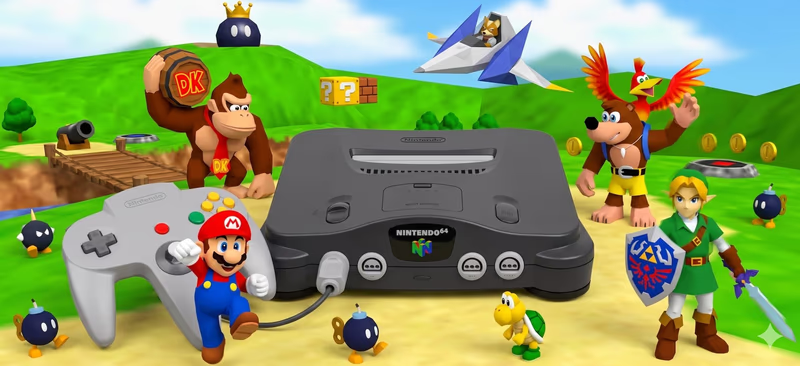
Nano Banana

In the early 1990s, as the 16-bit war between the Super Nintendo and Sega Genesis raged on, the looming transition to 3D graphics threatened to upend the industry. While Sony and Sega were developing their 32-bit CD-ROM consoles, Nintendo decided to leapfrog an entire generation.
In 1993, Nintendo announced a historic partnership with Silicon Graphics, Inc. (SGI), the titan of 3D workstation computing responsible for the CGI in Jurassic Park. Internally dubbed "Project Reality" (and later the "Ultra 64"), the mandate was wildly ambitious: put a multi-thousand-dollar SGI supercomputer inside a plastic box that families could afford. It was delayed multiple times as engineers fought to scale down the massive heat and cost of the SGI chips, but when the Nintendo 64 finally launched in 1996, it completely redefined what a video game could look and feel like.
As a hardware analyst who has benched hundreds of machines, looking back at the N64’s motherboard is fascinating. It was a wildly powerful, yet deeply bottlenecked piece of engineering.
Nintendo’s decision to use ROM cartridges instead of CD-ROMs was the most controversial hardware choice of the decade, fundamentally altering the trajectory of gaming history.
The Pros:
The Cons (The Cost of Stubbornness):
Initially released in a standard, sleek Dark Charcoal grey, Nintendo eventually realized the hardware itself could be a statement piece.
When the console launched, the critical reception was pure awe. Super Mario 64 is arguably the most important launch title in the history of the medium. The introduction of the trident-shaped controller with an analog stick—allowing 360-degree precision movement—blew minds. Before the N64, gamers navigated 3D spaces using the rigid D-pad; Nintendo taught the world how to walk, run, and sneak in three dimensions.
Users fell in love instantly, but frustrations grew over time. While the PlayStation enjoyed a relentless stream of weekly releases, N64 owners suffered through long "software droughts," waiting months for the next first-party masterpiece. Yet, when those masterpieces arrived (GoldenEye 007, Super Smash Bros.), the community rallied.
The Nintendo 64 was a profitable machine, but it marked the end of Nintendo's hardware monopoly. It sold 32.93 million units worldwide.
While these were solid numbers, it was thoroughly eclipsed by the Sony PlayStation, which moved over 102 million units. The N64 held onto roughly a 20-25% market share of the generation. It struggled particularly in Japan, but maintained a fiercely loyal and robust user base in North America, sustained almost entirely by the unmatched quality of Nintendo's first-party software and Rareware's incredible output.
For those of us who lived through it, the Nintendo 64 is more than a piece of hardware; it is a feeling. It is the glow of a CRT television on a Friday night, four tangled controller cords stretched across the carpet, and the chaotic sounds of a Mario Kart 64 race or a GoldenEye deathmatch.
Technically, its legacy is foundational. It gave us the modern analog stick. It introduced controller-based haptic feedback with the Rumble Pak. It pioneered "Z-targeting" in Ocarina of Time, solving the camera problem in 3D action games forever. It was the absolute zenith of local multiplayer gaming, proving that four controller ports built directly into the front of the machine could turn a living room into the ultimate social hub.
The N64 may have lost the storage war, but through sheer innovation and unforgettable software, it won our hearts.

Affiliate link: Support the blog via Instant Gaming at no extra cost.
Nintendo 64
Others Posts
The PlayStation 5 hardware architecture. We analyze Mark Cerny's custom I/O complex, the revolutionary 825GB SSD, liquid metal thermal engineering, and how Sony eradicated the traditional storage bottleneck.
We explore how a broken handshake between Nintendo and Sony birthed a 32-bit titan. By combining developer-friendly hardware, the vast storage of the CD-ROM, and an aggressive marketing strategy

We explore the Nintendo GameCube's surprisingly muscular architecture, its quirky, toy-like design, and the brutal market realities it faced against the DVD-playing juggernauts of its era.

We analyze the technological differences between LCD and OLED panels, redesigned acoustics, and connectivity to determine if the sensory upgrade justifies the generational leap.
We explore how Nintendo dominated the 16-bit console war not through sheer CPU speed, but through a masterful integration of custom audio-visual processors, revolutionary controller ergonomics, and an ingenious strategy of in-cartridge hardware expansion.
We dissect the brilliant foresight of its unified shader architecture and digital ecosystem, while critically examining the catastrophic thermal engineering failure of the "Red Ring of Death."

RoboCop: Rogue City: Teyon's faithful adaptation, Peter Weller's return, the sheer power of the Auto-9, and the gritty streets of Old Detroit.

Mutant Year Zero: Road to Eden: XCOM-style tactical combat, real-time stealth infiltration with Dux and Bormin, and the secrets of The Zone.
Conquer the toughest bosses in Minecraft Dungeons. Master attack patterns, exploit weak points, and equip the best builds for every major fight.
Are the Minecraft Dungeons DLCs worth buying? We break down all 6 expansions, their biomes, unique mechanics, boss fights, and rank the absolute must-haves.
games
Halo: Spartan Assault: 343 Industries' jump into the twin-stick shooter genre, the battles of Sarah Palmer, and the heavy baggage of its mobile origins.
